Confessions of a Recovering College Feminist
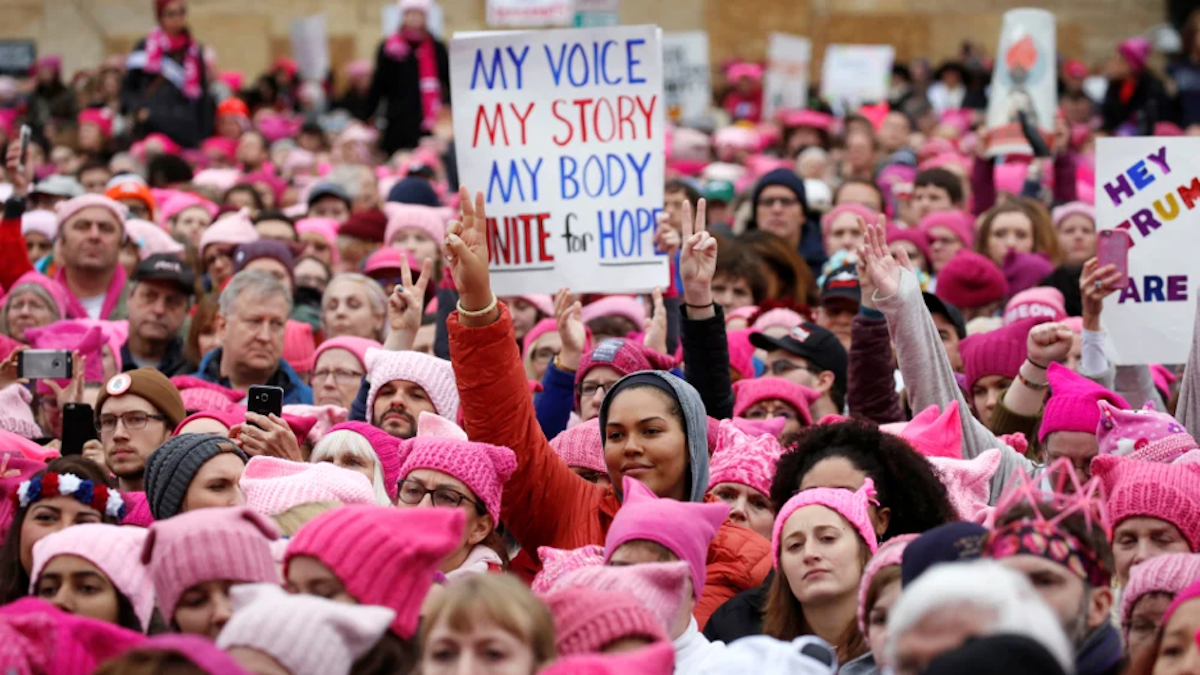
When I was in middle school, I discovered feminism on Tumblr. Always a voracious reader, I devoured every book on it that I could find—eagerly consuming the words of feminists like Germaine Greer, Betty Friedan, and Naomi Wolf. When I ran out of books to read, I turned my attention to the interwebs, where communities of social justice warriors congregate.
Little did I know it, as a young teen, I tumbled headfirst into the rabbit hole of the Tumblr social justice feminist orthodoxy—the perverse wonderland where up is down and everything is a manifestation of the patriarchy that hurts women.
Later, when I started attending college at the age of 14, I chose to take mostly feminist women’s studies courses while dual-enrolled at high school. I graduated from high school with 70 college credits (for reference, a degree needs about 120), then I applied to women’s colleges and a few other private schools like Brandeis and Macalester.
Ultimately, I was so steeped in feminism that I landed at Barnard College, and slowly, as I was surrounded by the feminist ideology in person, I realized the naivety of my own struggle against the “patriarchy,” which is just a theory and not a social reality.
Waking Up to the Reality of Living with Feminists 24/7
When I landed at Barnard, I was put into the school’s Social Justice House, of which all three of my roommates were feminists for Palestine. For me, feminism was an enticing religion. Growing up in a home devoid of faith, I eagerly accepted feminism’s philosophy as my ticket to mortal salvation.
As I steeped myself in this type of feminism: the type that emanates from online Tumblr echo chambers and the ideological enclaves of Women’s studies departments, it taught me a number of ideas and values I was eager to apply to my own life.
For example, feminist ideology taught me that any opinions that were conservative, or just didn’t align with the party line were violence. It also taught me that the best way to fight opposition is to try to silence it. Don’t like what someone says? Protest them. Shut their event down. Try to get people fired. That was the modus operandi at Barnard College of Columbia University, where I went for undergrad.
Suggest that men should have rights too? Bring up statistics on male homelessness or discrimination in the court system that benefits women? Off with your head!
In retrospect, the fact that I openly embraced an ideology that claimed conservative viewpoints are the same as life-threatening violence, isn’t just absurd, it’s embarrassing. How was I so deluded?
The advent of conservative speakers being de-platformed or harassed by screaming social justice warriors is a logical consequence of an ideology that equates conservative opinions with physical violence.
This happened many times in college, like, when Milo Yiannopoulos’s speech at DePaul University came to an end when two social justice warriors ran onto the stage and hijacked the mic in protest of Milo’s views.
Safetyism and The Microaggressions Arch in Social Justice
Where I lived growing up, people have been shot just minutes away from me, sometimes on my very same street. I’ve woken up to the sound of gunshots, and two people I went to high school with have already been killed. Once, age 18 and renting alone, I woke up to hearing that a man was dead on our lawn, killed in a drive-by shooting.
Violence, real violence, is an omnipresent threat in the city where I’m from.
When I went around preaching to my friends that homophobic or sexist language was an act of violence as a feminist, someone should have called me a fool, slapped me upside the head, and told me to climb back out of the social justice rabbit hole before I made it my grave.
Feminism also taught me about microaggressions, which thankfully aren’t as much of an hot-topic issue now in 2025. Rarely did I go a day without interpreting what someone said as such, as a personal affront to myself or one of the 7 marginalized identities that feminist social-justice Tumblr gifted me.
Social justice theory also taught me that anyone who said anything I didn’t agree with was sexist or homophobic. For example, if someone brought up the fact that some research suggests lesbians and gay men have a disproportionately higher rate of engaging in domestic violence, the feminist rebuttal would essentially be to accuse the other person of being a homophobe instead of engaging in dialogue.
Feminist theory also taught me that the best way to fight oppression was to call people out. Unfortunately, what feminism doesn’t tell you is that running around making accusations of sexism towards everyone you disagree with isn’t productive. Nonetheless, calling people out became sort of a competitive sport for me.
In retrospect, I wonder if maybe I was a little bit too extreme of a social justice feminist; not all feminists go around calling people racists or sexists, right?
Not all of them. But many do; many of my former peers volley accusations of racism and sexism daily online, still holding onto feminism into their late 20s and early 30s. When I look at their politics and the way they advance it now, I think of my younger self. I think about the time I called my friend a racist because she was culturally appropriating Native American for using a dreamcatcher as a room decoration. Or the time I called one of my friends a “sexist” when he defended catcalling because it’s “a part of inner-city culture.”
What Changed?
Of course, not all feminism preaches the ideas I’ve described. Dissident feminists such as Camille Paglia, Meghan Daum and Christina Hoff Sommers still carry the torch for a different kind of feminism. One that has its roots in classical liberalism and the promotion of agency, not victimhood. Unfortunately, this is not the type of feminism that appeals to most women.
My romance with feminism came crashing down after I tried to crash a few libertarian and conservative conferences and training programs to “infiltrate” them. But instead of going to these conferences and finding the hate I was looking for, but instead I found hope for a strong America and people dedicated to constitutional rights.
That happened during my first and second year at Columbia, and when my feminist views changed I instantly lost friends overnight. Earlier, I refused to sign a petition by SJP to boycott Israel, and I lost most of my friend group. But what I gained was insight and clarity and ultimately, a deep appreciation for heterodox thinking and of the Jewish students and alumni who stuck by me while I was being harassed for supporting Israel.
Eventually, I no longer considered myself a feminist.
I fell out of love, spurned by the indiscriminate anger and logical fallacies commercial feminism commits itself too. My blissful union with feminism ended in the same way that any long-term relationship does: with hurt feelings, a little embarrassment, and a pang of remorse over what could have been. I still resist the urge to call Subway sandwiches “phallic objects” like I learned in my first women’s studies course. I still have to resist the urge to join every protest just because “protesting is fun”, something we’ve heard from radical liberal SJP students recently. But I’m learning, forever haunted by my sojourn down the feminist rabbit hole.
This opinion piece was brought to you by Toni Airaksinen, Senior Editor of Liberty Affair and a journalist based in Delray Beach, Florida. Follow her on Substack , on X @ Toni_Airaksinen and Instagram @Toni_Airaksinen.