Could John F. Kennedy Be a Republican Today?

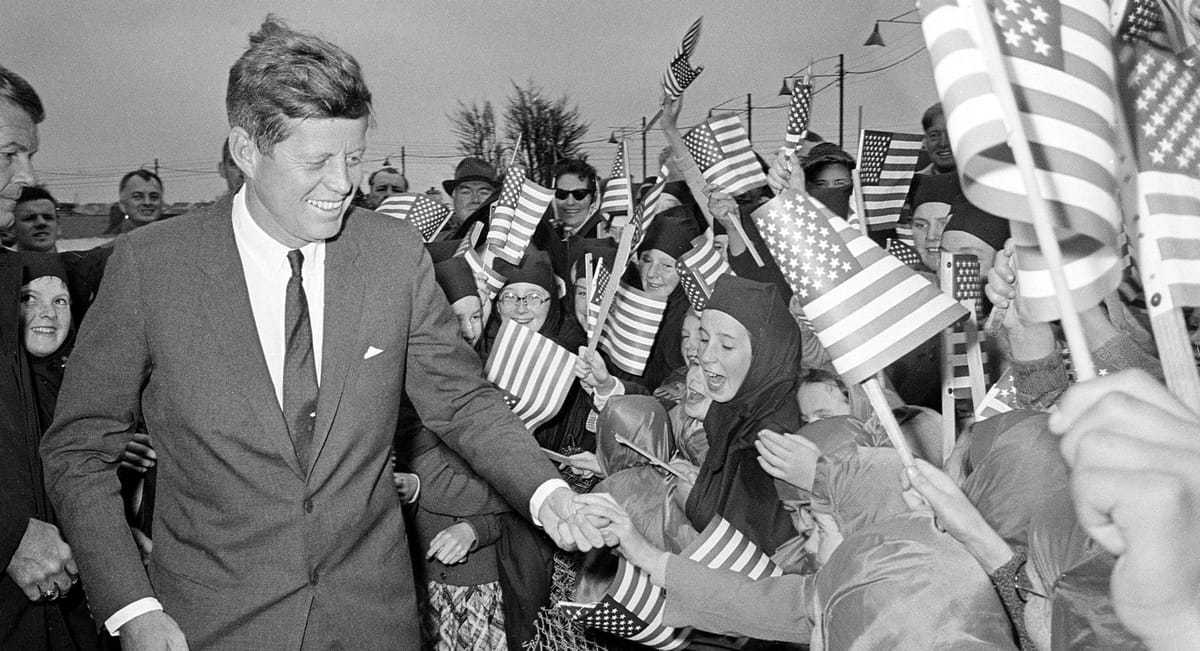
On this poignant anniversary of President John F. Kennedy’s assassination, I find myself reflecting not just on his legacy but on the ways in which his vision for America resonates in our current political climate. November 22, 1963, marked the end of a presidency defined by youthful ambition, lofty ideals, and a sophisticated vision for America’s future. Sixty-one years later, JFK remains my favorite president, a testament to his ability to inspire across party lines and throughout generations.
As a New Englander from a Catholic family, I grew up with the Kennedy name woven into the fabric of my life. My grandparents admired the Kennedys as a symbol of hope and progress, and stories of their leadership, charm, and tenacity were commonplace in our conversations. I’ve even had the privilege of meeting a few members of the Kennedy family, which deepened my personal connection to their legacy. Though my political views have evolved over time—leaving the Democratic Party in 2017 to become an Independent and later leaning more towards conservatism—John F. Kennedy remains a figure I admire deeply. In many ways, his independent-minded leadership feels like a relic of a bygone era, a time when presidents could rise above party orthodoxy to chart a bold and principled course for the nation.
This independent-mindedness, I believe, would place Kennedy firmly at odds with today’s Democratic Party. Like his nephew, Robert F. Kennedy Jr., JFK likely would have found himself deeply critical of the party’s shift towards both ideological and tactical extremes, as well as identity-driven politics. As someone who also grew disillusioned with the Democratic Party, I see parallels between my critiques and the ones JFK himself might have voiced. His emphasis on unity, shared sacrifice, and patriotism contrasts sharply with the fractured and often divisive rhetoric that dominates today’s political discourse.
JFK’s legacy is one of principle, pragmatism, and a belief in the particular greatness of America. Ira Stoll’s book, JFK Conservative (2013), highlights how many of Kennedy’s positions—especially on economic and foreign policy—align more closely with modern conservatism than with the increasingly intense progressivism of today’s Democratic Party. Kennedy’s tax policies, for example, emphasized economic growth through lower corporate tax rates. Famously declaring that “a rising tide lifts all boats,” he championed a significant reduction in the top marginal tax rate—from over 90% to 65%—to stimulate investment and productivity (ironically, many Republicans opposed this at the time). This supply-side economic approach mirrors the policies of Ronald Reagan and other, more recent Republican leaders, who have sought to spur growth by empowering the private sector.
Kennedy’s approach to foreign policy similarly reflected his independent spirit and unshakable resolve. His handling of the Cuban Missile Crisis—staring down Nikita Khrushchev with resolute determination—showed a leader unafraid to take a stand for American interests, even at great risk. His staunch anti-communism and belief in peace through strength (a philosophy Trump now advocates) echo the national security priorities of today’s Republican Party far more than the left’s. Yet JFK was no war hawk; his reluctance to escalate the conflict in Vietnam reflects a measured pragmatism that is increasingly rare in modern politics, especially on the left. Would the hawkish Cheneys have endorsed the 35th president as they did Kamala Harris? I doubt it.
That being said, Kennedy also distinguished himself through his ability to build bridges across party lines. His tax reform, which lowered both corporate and individual tax rates, required collaboration with some Republicans who shared his belief that a thriving private sector could benefit all Americans. He framed his policies not as partisan victories but as solutions for the common good, uniting the nation behind a shared purpose. This pragmatism extended to foreign policy as well. During the Cuban Missile Crisis, Kennedy actively sought counsel from advisors with differing viewpoints, demonstrating his openness to perspectives different from his own. His commitment to finding common ground, even in moments of immense pressure, set him apart as a leader who prioritized the country’s welfare over petty ideological purity.
Personally, I have always admired his ability to balance vision with pragmatism, a trait that is often lacking in our current crop of political leaders. JFK’s push for space exploration is a perfect example: his bold declaration that America wouldland a man on the moon within the decade inspired a nation to believe in the extraordinary. This kind of ambitious leadership, grounded in optimism and faith in America’s potential, feels worlds away from the smallness and cynicism that too often define today’s politics. Kennedy believed in doing the hard things—not for their ease but for their importance—and that mentality is sorely needed in our fractured, short-term-focused political climate.
Kennedy’s leadership also stood out for its grace and resilience. Despite suffering from chronic health issues, including debilitating back pain and Addison’s disease, he projected strength and confidence. His ability to lead with dignity, regardless of personal struggles, deepened the public’s admiration for him and cemented his image as a determined and capable president.
Of course, JFK was not without flaws. His administration faced criticisms, including a more piecemeal approach to civil rights early on and the disastrous Bay of Pigs invasion (which was not entirely his fault). But even in his missteps, Kennedy displayed a willingness to learn and adapt—a quality that distinguishes great leaders from merely good ones. By the time of his assassination, his commitment to civil rights had strengthened, and his leadership on the issue helped lay the groundwork for the transformative legislation that followed under Lyndon B. Johnson.
As I reflect on my own political journey, I can’t help but wonder how JFK would view the Democratic Party today. Like his nephew, RFK Jr., he might find himself estranged from a party that has drifted far from the values of unity, personal responsibility, and shared sacrifice that he championed. RFK Jr.’s willingness to challenge Democratic orthodoxy—particularly on issues of censorship, corporate influence, and public health—feels very much in line with JFK’s independent spirit. While their views on certain issues would absolutely differ, both share a commitment to questioning authority and standing on principle, even when it’s unpopular.
Kennedy’s legacy as a leader willing to stand up to entrenched interests is particularly striking in today’s context. His skepticism of the intelligence community and military establishment, demonstrated by his resistance to aspects of the Bay of Pigs invasion and his cautious approach to Vietnam, would resonate with critics of the so-called “deep state” (or the “military-industrial complex” his predecessor had so inauspiciously warned of). This independent-mindedness cost him dearly at times, but it also defined his presidency as one of integrity and vision.
Kennedy’s policies on the economy further highlight how out of step he would be with today’s Democratic Party. His belief in free enterprise and economic growth clashes with the anti-corporate rhetoric of progressive leaders like Elizabeth Warren and Bernie Sanders. While JFK recognized the importance of government in addressing big challenges, such as space exploration and civil rights, he also understood that a thriving private sector was essential to America’s success. His reduction of corporate tax rates and emphasis on economic growth as a driver of prosperity place him far closer to the modern right than to the modern left.
Even on social issues, Kennedy’s views might align more with today’s centrists or conservatives than with the progressive wing of the Democratic Party. While abortion was not a major political issue during his presidency, his Catholic faith likely informed a somewhat more traditional perspective on the sanctity of life. It’s hard to imagine JFK fully embracing the Democratic Party’s current platform on abortion, which has moved significantly leftward since the Roe v. Wade decision in 1973.
Had JFK lived, the trajectory of the Vietnam War might well have been vastly different. His reluctance to commit large numbers of ground troops suggests he would have sought alternative solutions, possibly avoiding the abysmal quagmire that defined LBJ’s presidency. This counterfactual compounds the tragedy of his assassination—not just for what was lost, but for what might have been. His vision for America extended far beyond the crises of his brief tenure at 1600 Pennsylvania Avenue. His commitment to “moonshot” efforts such as space exploration, his non-partisan demeanor, and his ability to inspire a nation all reflect a leadership style that went beyond party politics.
As we remember JFK on this tragic anniversary, his legacy transcends partisan boundaries. He remains a symbol of ambition, courage, and the pursuit of greatness—qualities that inspire Americans regardless of their political affiliations. While JFK might not fit neatly into today’s Republican Party, his values and policies suggest he could certainly find common cause with modern conservatives, perhaps even more than with today’s progressives. For me, as someone who has moved away from the Democratic Party but still admires its greatest leaders, JFK represents a time when presidents could rise above the fray and lead with dignity, vision, and principle. Could he be a Republican today? I think so; however, perhaps the better question is whether either party could rise to the standard he set.
Michael J. Hout is the Editor of Liberty Affair. He currently resides in Warsaw, Poland. Follow him on X: @michaeljhout