DC Shooter’s Manifesto: How Antisemitic Rage Led to Murder of Israeli Embassy Workers
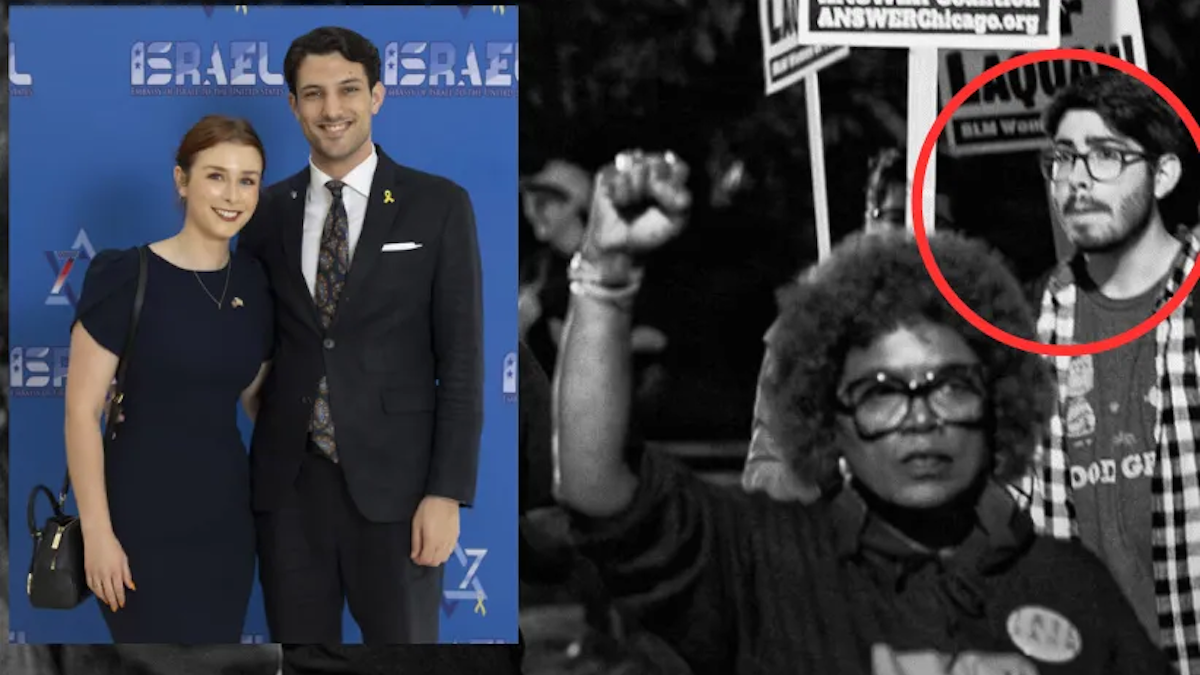
The following is Elias Rodriguez’s manifesto, published a day before he entered the Capitol Jewish Museum, where two people—Yaron Lischinsky, 30, and Sarah Milgram, 27—were killed. The two were a couple, and Yaron had planned to fly to Israel next week with her to propose in front of her family.
The following is the manifesto he published. It has since been heavily censored, with many news organizations only referencing bits and pieces of it. But in the interest of full transparency—which I believe serves the public good—I am sharing it here.
The facts and numbers he cited have not been independently verified. It appears the killer of Yaron and Sarah is repeating much of the same anti-Jewish propaganda currently emanating from Hamas supporters and their allies’ well-funded disinformation apparatus.
May 20, 2025
Halintar is a word that means something like thunder or lightning. In the wake of an act, people look for a text to fix its meaning—so here’s an attempt. The atrocities committed by Israelis against Palestine defy description and quantification. Instead of reading descriptions, mostly we watch them unfold on video—sometimes live.
After a few months of rapidly mounting death tolls, Israel had obliterated the capacity to even continue counting the dead, which has served its genocide well. At the time of writing, the Gaza Health Ministry records 53,000 killed by traumatic force. At least ten thousand lie under rubble, and who knows how many thousands more have died of preventable disease and hunger, with tens of thousands now at risk of imminent famine due to the Israeli blockade—all enabled by Western and Arab government complicity.
The Gaza Information Office includes the ten thousand under the rubble in their death toll. For months now, news reports have repeated the figure of “ten thousand” trapped below, despite the continual creation of more rubble, repeated bombings of that rubble, and even bombings of tents set up amidst it.
Like the Yemen death toll—which was frozen at just a few thousand for years under Saudi-UK-US bombardment before it was belatedly revised to 500,000—all of these figures are almost certainly a criminal undercount. I have no trouble believing estimates that place the toll at 100,000 or more. More have been murdered since March of this year than in Protective Edge and Cast Lead combined.
What more can be said about the proportion of mangled, burned, and exploded human beings who were children? We who let this happen will never deserve the Palestinians’ forgiveness. They’ve let us know as much.
An armed action is not necessarily a military action. It usually isn’t. Usually, it is theater and spectacle—a quality it shares with many unarmed actions. Nonviolent protest in the opening weeks of the genocide seemed to signal some kind of turning point. Never before had so many tens of thousands joined Palestinians in the streets across the West. Never before had so many American politicians been forced to concede, at least rhetorically, that Palestinians were human beings, too.
But so far, the rhetoric has not amounted to much. The Israelis themselves boast about their shock at the free hand Americans have given them to exterminate the Palestinians. Public opinion has shifted against the genocidal apartheid state, and the American government has simply shrugged. They’ll do without public opinion, then—criminalizing it where they can, suffocating it elsewhere with bland reassurances that they’re “doing all they can” to restrain Israel.
Where protest cannot be outlawed, it will be buried in bureaucracy or dismissed as fringe. Aaron Bushnell and others sacrificed themselves in the hope of stopping the massacre. The state wants us to feel their sacrifices were in vain—that there’s no hope in escalating for Gaza, no point in bringing the war home. We can’t let them succeed. Their sacrifices were not in vain.
The impunity that representatives of our government feel at abetting this slaughter must be revealed as an illusion. Impunity is worst for those of us in close proximity to the genocidaires. A surgeon who treated victims of the Guatemalan state’s Mayan genocide recounted an instance in which he was operating on a patient critically injured during a massacre. Suddenly, armed gunmen entered the room and shot the patient dead on the operating table—laughing as they did so. The physician said the worst part was seeing the killers, well-known to him, swagger down the local streets in the years that followed.
Elsewhere, a man once attempted to throw Robert McNamara off a Martha’s Vineyard-bound ferry, incensed by the same impunity and arrogance he saw in the butcher of Vietnam, who was laughing with friends in the lounge. The man said he took issue with McNamara’s “very posture, telling you, ‘My history is fine, and I can be slumped over a bar like this with my good friend Ralph here and you’ll have to lump it.’”
The man failed to throw McNamara off the ferry. The former Secretary of State clung to the railing and clambered back to his feet. But the assailant later explained the value of the attempt: “Well, I got him outside, just the two of us, and suddenly his history wasn’t so fine, was it?”
A word about the morality of armed demonstration. Those of us against the genocide take some satisfaction in arguing that the perpetrators and abettors have forfeited their humanity. I sympathize with this view. It helps soothe a psyche that cannot bear the atrocities it witnesses—even through a screen.
But inhumanity has long since proven itself to be shockingly common—mundane, even prosaically human. A perpetrator may still be a loving parent, a devoted child, a charitable friend, a kind stranger—capable of moral strength when it suits him, or even when it doesn’t—and still be a monster all the same. Humanity doesn’t exempt anyone from accountability.
This action would have been morally justified 11 years ago, during Protective Edge, around the time I first became aware of our brutal conduct in Palestine. But I think most Americans would’ve found it illegible back then—insane, even. I’m glad that today there are Americans for whom this action will be highly legible—and, in a strange way, the only sane thing to do.
I love you Mom, Dad, baby sis, the rest of my familia—including you, O*****
Free Palestine
—Elias Rodriguez
This report was brought to you by Toni Airaksinen, Senior Editor of Liberty Affair and an independent journalist based in Boca Raton, Florida. Follow her on X @Toni_Airaksinen, and on Instagram.