Freud Was Right: Without Dad, Parenting Can Turn Pathological
This article is written by Dr. Hannah Spier, a medical doctor who trained in psychiatry in Norway and Sweden. She describes herself as “The Antifeminist Psychiatrist” and aims to expose bad therapy and and the liberal narratives that contribute to our poor health.
50% of women in their 30s are childless—and we are desperate to find out why.
How can we expect people to imagine their own children will be any different from
children they are modelled? After witnessing their nephew hold his parents hostage
at Christmas with nothing but a glare and a gluten allergy, any reasonable person
would go home thinking—perhaps we’ll travel and enjoy ourselves just one more
year.
The reason is that my generation fell for gentle parenting in some form or
another—many won’t even realize that’s what they’re doing. This isn’t just about
those who explicitly subscribe to it, which is why I’ll use the term millennial parenting
for my purposes here. The style has permeated the culture, thanks to the dominance
of maternal influence, a sentimentalized view of childhood, and the slow
displacement of men from the family structure.
The Empathy Delusion
For my peers, empathy and understanding is the solution to absolutely everything.
They try not to say “No” or “Stop!” They’ll say, “Let’s try it differently!” And when their
toddler smacks his sibling, they crouch down, eyes wide with therapeutic concern,
and announce, “I feel very sad when you hit. What do you feel?”
When this inevitably delivers anxiety and defiance, they go to a professional in
search of a neuropsychiatric answer.
Gentle and millennial parenting rests on a noble seeming but ultimately naive belief:
empathy is a universal solvent. That if we just validate enough feelings and explain
enough boundaries, our children will spontaneously develop into self-regulating,
emotionally literate mini adults. If parents can just stay calm and “co-regulate”
tantrums without ever imposing top-down oppressive control, their kids will blossom
into wise, kind humans.
That’s equal to believing that if I eat enough chicken, I’ll learn to fly.
Millennials project their own perceived complexity, preciousness and adult
intelligence onto children. Therefore, the only reason a child can misbehave is
because they don’t understand.
It began with Rousseau, who painted children as innocent blank slates. Pure beings
corrupted only by society. That idea, now wrapped in pseudo-spiritual neurobabble
and Instagram aesthetics, leads parents to believe bad behaviour is simply a byproduct of a developing prefrontal cortex. “Neurons firing”.
So rather thancorrecting or punishing misbehaviour, the millennial parent is encouraged to patiently
narrate feelings and offer guidance. Never “mean” consequences.
But here's the irony: true empathy doesn’t arise from being endlessly validated. It
arises from feeling safe. And safety for a child comes from structure. Knowing that
their parent will act as a buffer between them and the terrifying world outside.
Have you ever had an anxiety attack or panic? And when in the throes of such an
attack, did you stop and ask someone how they’re doing? Of course, not. Because dysregulation naturally turns us inward.
You must secure your own safety before you can extend care to others. And children, can’t be empathic when they feel emotionally uncontained. They certainly won’t feel secure when the adult in charge is too busy narrating their own emotional state to provide order.
It follows that only within the solid fences a parent ensures, will play unfold, and it is
through play that they learn empathy. Psychologist Jordan Peterson emphasizes that through play, children learn to interpret social cues, understand others' perspectives, and develop emotional
responses aligned with societal norms.
Research from McGill University found that "the single most important childhood
factor in developing empathy is paternal involvement in childcare." While children can
show signs of empathy from an early age, a full theory of mind (the ability to
understand that others may have different beliefs) typically develops around age four.
Paternal warmth has been significantly positively related to empathy in children,
especially boys, while maternal warmth has shown a negative relation to empathy in
children, particularly girls.
The gentle parent puffs out her chest, talking about time-outs and boundaries (the
buzzword of the decade). When push comes to shove, however, what mechanism is
there to keep a misbehaving child in said time-out? Without earned respect for the
parent’s word, implementing consequences becomes impossible. Without authority, a
parent is as effective as a wet blanket.
The Vanishing Father and the Performative Mother
We’ve built a culture that glorifies the feminine traits of nurturing and empathy, while
treating masculine ones—authority, discipline, stoicism—as dispensable. A
necessary move for the normalization of single motherhood. When fathers do instinctively enforce those boundaries, they’re waved off or subtly undermined. “That’s too harsh,” she says. “Let’s talk about it instead.”
And so, the father withdraws. He’s becomes uncertain, ashamed and less inclined to step in next
time.
I see it constantly as a psychiatrist. The mother rolling her eyes at her child’s misbehaviour, as if to
say, “This is just so unexpected.” The banana peel tossed into a stranger’s handbagis met with performative disbelief. Can you believe he just did that? Like distancing themselves from their child’s behaviour somehow absolves them of the responsibility to correct it.
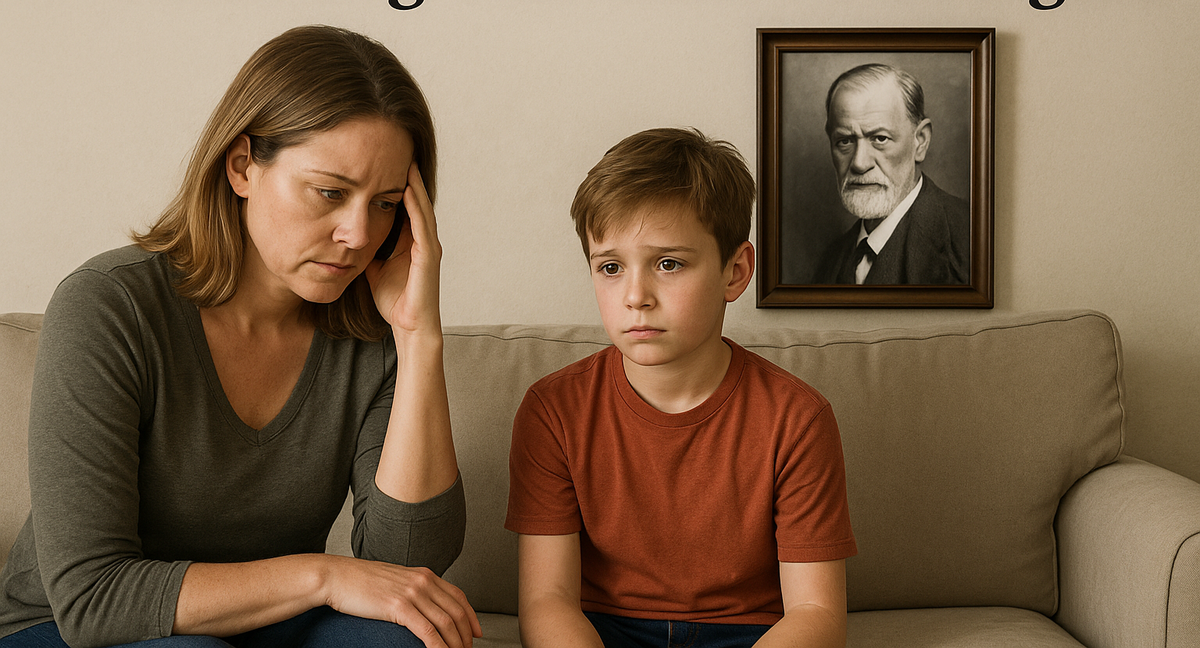
This is Freud’s devouring mother, in modern packaging: nurturing turned pathological
in the absence of masculine balance. We forget that parenting is meant to be shared.
The gentle parenting paradigm is only possible when the father’s instinct to lead is
either shamed out of him or pushed out entirely.
The kids learn quickly that mom’s boundaries mean nothing, and dad’s voice will be
silenced. There’s no real authority, only a hierarchy where the child rules.
The Data Is Clear (But Ignored)
Decades of developmental research affirm that authoritative parenting, not
permissive or authoritarian, produces the best outcomes. Diana Baumrind’s original
work, and many studies since, have shown that children raised with high warmth and
high control outperform others emotionally, academically, and socially.
Permissive parenting (which gentle and millennial parenting invariably is), in contrast,
is correlated with higher rates of anxiety, impulsivity, and risky behaviour. But we
don’t like hearing that anymore. We’d rather believe in the redemptive power of
emotional mirroring than confront the reality that children are not born with
exclusively good impulses.
They don’t need a mirror to facilitate understanding. They need a wall. A loving,
steady, immovable wall that tells them where the world begins and ends. Then, and
only then, can they begin to move confidently within it, tame bad impulses, making
way for generosity towards others.
Follow Dr. Hannah Spier at PsychobabbleWithSpier. She is based in Switzerland. You can keep up with her writings on X: @hannahspierMD.