How Trump’s Tariffs on China Sparked a New U.S. Industrial Strategy
The Strategic Pivot: Trump’s Tariff Policy and the First Break with China
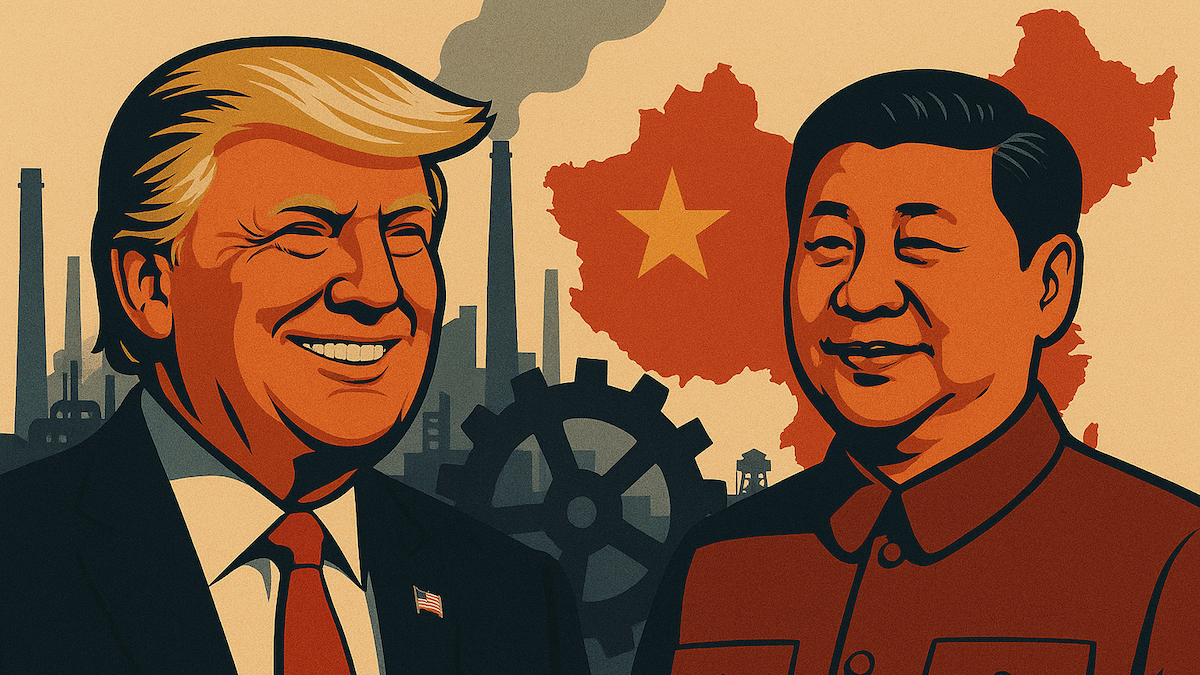
The Trump administration’s 2017 decision to impose sweeping tariffs on Chinese imports was far more than a headline-grabbing trade war—it marked the first serious challenge to the United States’ decades-long economic entanglement with China. For nearly two decades, Washington had pursued trade liberalization under the belief that economic integration would eventually liberalize China’s political system and bind it to the Western-led global order. That hypothesis proved disastrously wrong, leaving the U.S. with a $350+ billion trade deficit and a supply chain architecture that outsourced critical industrial capabilities to an increasingly adversarial power. The tariffs served as a hard reset, signaling that the United States would no longer accept industrial hollowing in exchange for cheap consumer goods. Critics called it a trade war, but in truth, the war had been one-sided—America had simply never fought back. From 2017 to 2020, U.S. imports from China declined markedly. Corporate boardrooms began reassessing supplier risk, and terms like “reshoring” and “decoupling” migrated from white papers to earnings calls. For the first time in decades, industrial policy reemerged at the center of American strategic thinking.
The Post-2021 Shift: Decoupling in Name, Recoupling in Practice
The Trump tariffs disrupted the old paradigm. However, when the administration ended in early 2021, so did the momentum. Although the tariffs largely remained in place, their strategic intent was diluted. The rhetoric of decoupling persisted, but trade dynamics quietly shifted. Instead of direct imports from China, the U.S. began sourcing Chinese-made components via third countries. Vietnam, Mexico, Malaysia, and others became staging grounds for Chinese intermediates. Products were repackaged, relabeled, and re-exported to the United States, technically avoiding tariffs but preserving dependency. This created an illusion of diversification. Supply chains appeared more globally distributed, yet core inputs—pharmaceutical precursors, electronic subcomponents, rare earth elements—still originated in China. This backdoor recoupling underscored a key point: without coherent enforcement mechanisms, tariffs alone cannot untangle economic dependencies. Worse, it allowed critical vulnerabilities to persist under the guise of reform.
Fragility in the Arsenal: The Pentagon’s Strategic Alarm
Nowhere is this vulnerability more apparent than in the defense sector. A draft of the Pentagon’s 2023 National Defense Industrial Strategy offered a stark warning: the current U.S. defense-industrial base would struggle to provide capabilities “at the speed and scale” required in a major conflict. Causes include capacity constraints, a limited number of suppliers, and, most alarmingly, overreliance on foreign-made components. Consider the Lockheed Martin plant in Alabama, where each Javelin missile requires over 200 semiconductors. Multiply that across thousands of units and you confront a chilling reality: thousands of Chinese-made chips embedded in frontline American weaponry. These semiconductors are often sourced indirectly—purchased through global distributors or integrated into modules without transparent country-of-origin labeling. The result is the same: an exploitable dependency. It’s not just Javelins. In 2023, air-launched weapons such as the Joint Air-to-Surface Standoff Missile (JASSM), the Naval Strike Missile, the Tomahawk cruise missile, and the Harpoon all contained components sourced from China. In a future conflict—especially in the Pacific, where U.S. forces may face the PLA Navy directly—such dependencies could prove catastrophic.
China’s Coordinated Industrial Strategy vs. America’s Strategic Awakening
No country has been more methodical in its industrial strategy than China. Combining state planning, capital discipline, and geopolitical intent, Beijing has transformed itself into the world’s foremost industrial power. This transformation was no accident; it was the product of long-term vision and the strategic treatment of economic capability as national security. For too long, the United States underestimated this shift. It wasn’t until 2017, under President Donald J. Trump, that America decisively began to confront the challenge. For the first time in a generation, U.S. trade and industrial policy were guided by strategic realities rather than abstract economic theory. The tariffs on Chinese goods marked a fundamental shift—a signal of strategic recalibration.
Beijing’s Playbook: State-Backed Industry, Globally Deployed
To appreciate the magnitude of the challenge, one must understand China’s playbook. In China, private industry and the state apparatus are fused. Firms like Huawei, CATL, and DJI operate in coordination with the government to dominate global markets and advance national objectives. DJI, for instance, became the global leader in consumer and tactical drones through a mix of innovation, aggressive pricing, and unwavering state support. Chinese capital enabled rapid scaling, regulatory preference created safe harbor at home, and open international markets—including the U.S.—facilitated global dominance. DJI’s drones are dual-use platforms: tools for civilian infrastructure in peacetime and real-time intelligence assets in wartime. China's state-directed approach ensured DJI became not just a commercial success, but a strategic lever.
America’s Response: Shifting the Paradigm
The Trump administration recognized this asymmetry early. Unlike its predecessors, it rejected the illusion that market forces alone would preserve strategic autonomy. Industrial policy reentered the national conversation—not as an ideological relic, but as a necessary shift. Confronting China on trade triggered a deeper reevaluation of U.S. economic assumptions. For decades, “picking winners and losers” was considered taboo. The Trump administration challenged that orthodoxy, reviving the understanding that statecraft and economics are inseparable, particularly in national security sectors. The administration’s stance sparked a reshoring movement, with manufacturers beginning to reconsider supply chain strategies. Though reindustrialization is a long-term process, the foundational architecture was laid during Trump’s tenure.
Skydio and the Strategic Need for Support
A clear example of this evolving landscape is Skydio, an American drone company. As the U.S. aimed to reduce reliance on foreign drone technology, Skydio emerged as a key domestic alternative. Its advanced autonomous drones have drawn attention from defense agencies. However, the broader policy environment remains fragmented. While the Trump administration took vital steps—sanctioning DJI, restricting Chinese tech access, and promoting domestic alternatives—the U.S. still lacks cohesive industrial support. In China, industrial champions benefit from subsidies, vertically integrated supply chains, and political coordination. In the U.S., support often consists of one-off contracts or small grants. Though improving, the shift from market absolutism to strategic support remains incomplete. Tellingly, China recently sanctioned Skydio—a strategic move acknowledging the threat it poses to Chinese technological dominance. It’s evidence that Trump-era policies are having a tangible impact.
Toward a New Era of Industrial Sovereignty
The United States now faces an urgent opportunity to build on the work initiated between 2017 and 2020. The pandemic, the war in Ukraine, and growing tensions in the Indo-Pacific underscore the need for secure, domestic supply chains. Key sectors—drones, semiconductors, pharmaceuticals, rare earths—are no longer just economic; they are strategic. Rather than abandoning free-market principles, the Trump-era approach should be seen as an evolution: sustaining market dynamism while restoring national resilience. The goal is not centralization but the defense of critical economic nodes. The Trump administration took the essential first step: naming the problem. Now, the challenge is to develop comprehensive policy tools—from financing and procurement to regulatory reform and supply chain security. This won’t be accomplished through short-term incentives alone. It demands strategic patience and political resolve. The path is clear, and it’s no longer about ideology. It’s about sovereignty.
Sources and Further Reading:
- https://arc-group.com/china-thriving-drone-industry/
- https://daxueconsulting.com/dji-in-china-drones-technology/
- https://www.bea.gov/news/2025/us-international-trade-goods-and-services-december-and-annual-2024
- https://katanamrp.com/blog/supply-chain-disruption-examples/
- https://www.stlouisfed.org/on-the-economy/2024/jan/decoupling-where-it-matters-us-imports-from-china-in-critical-sectors
- https://news.cgtn.com/news/2023-08-29/U-S-supply-chains-still-dependent-to-China-paper-finds-1mF1Mqv5lM4/index.html
- https://www.federalreserve.gov/econres/notes/feds-notes/as-the-u-s-is-derisking-from-china-Other-foreign-u-s-suppliers-are-relying-more-on-chinese-imports-20240802.html
- https://thehill.com/opinion/5090860-us-china-trade-war-impact/
- https://www.forbes.com/sites/davidjeans/2025/04/16/silicon-valley-drones-china-problem/
- https://www.wnd.com/2024/07/shocking-number-critical-u-s-military-equipment-components-made-china/
- https://www.defensenews.com/opinion/2024/02/15/how-to-end-chinas-chokehold-on-the-pentagons-supply-chains/
Ziya H. is a Contributor for Liberty Affair. He lives in Warsaw, Poland. Follow him on X: @hsnlizi