Mourning in America

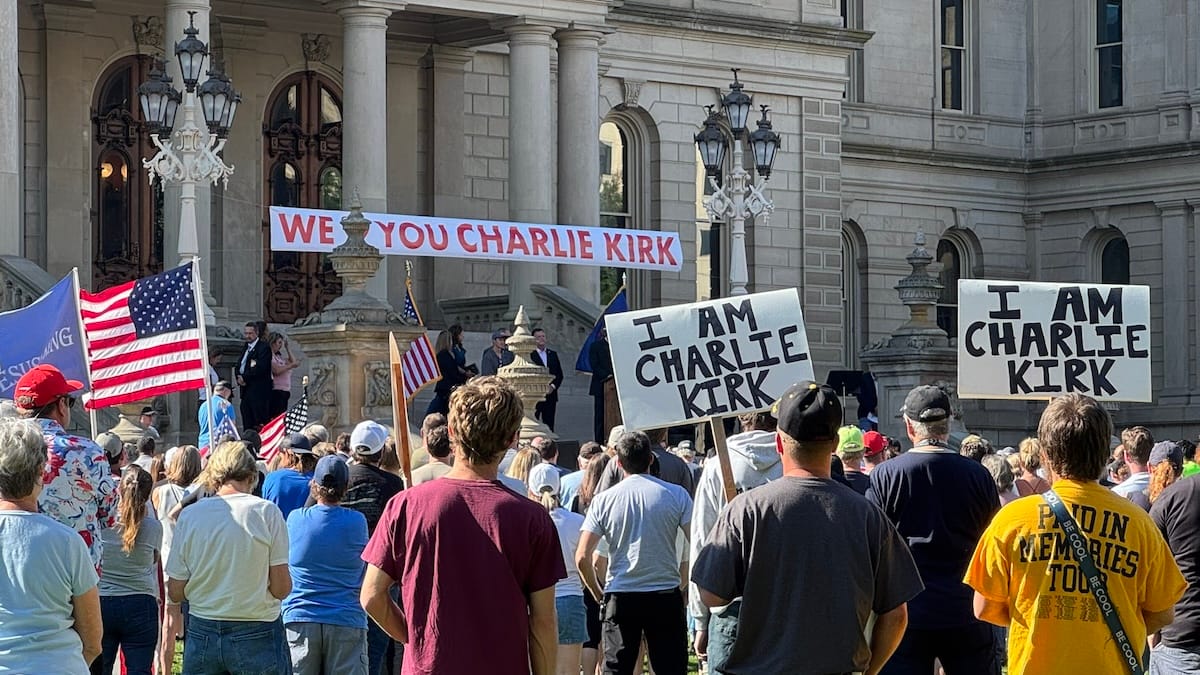
In 1984, Ronald Reagan’s campaign boldly declared that it was “Morning in America.” The country, he said, was waking to new possibilities, stronger families, and a renewed sense of unity. More than forty years later, America wakes to something far less optimistic — a discomforting reminder that our world is comprised of more wickedness than we should like to accept.
If you are anything like me (a human being), this past week has been one of profound sorrow. We are mourning Charlie Kirk — just 31 years old, husband to Erika, father to two small children — whose assassination has forced the nation to confront not only a terrible loss, but the depth of its own divisions.
On the right, the response has been raw grief. People feel they’ve lost not only a political leader but a good man, a husband and father who put God and family first. His murder carries the weight of losing a civil rights leader — someone whose life was given to a cause greater than himself. Across the conservative movement, there has been one emotion above all: mourning.
On the left, the responses have ranged from cold indifference to outright celebration. At the extremes, figures like the streamer Destiny and the commentator Hasan Piker have reveled in cruelty. Destiny, in particular, mocked Erika Kirk in her widowhood, told Republicans they should fear going to public events, and even interrupted Charlie’s grieving friend, Jack Posobiec, on live television. Others, less brazen but no less callous, have offered “qualified mourning”: I didn’t agree with him on anything, but… as if even in death they must signal their distance. Both responses, the ghoulish celebration and the coward’s eulogy, flow from the same poisoned well.
Douglas Murray, speaking on Fox News, put it perfectly: “This is a very, very big divide that we see, and it is not left and right. It’s between the decent and the indecent.” A recent YouGov survey bears that out. While only 8% of Americans overall said it was acceptable to be happy about the death of a political opponent, nearly a quarter of self-identified “very liberal” respondents did. The same survey showed liberals were far more likely than conservatives to justify political violence. The celebratory responses we have seen online are not just isolated ghouls acting out on social media — they reflect a troubling current within American political life. It is a current that must be condemned without qualification.
Some commentators, eager to appear balanced, have rushed to say “both sides” must be condemned equally. But the numbers tell a different story. Vastly more conservatives reject violence than liberals, and that matters. I personally know many conservatives who prayed for President Biden when his cancer diagnosis was announced. That spirit of humanity is real, and it exists across the right. It is not mirrored on the left, where one in four “very liberal” Americans say it is acceptable to be happy about a political opponent’s death, and where belief in political violence as a legitimate tool runs six to one higher than among conservatives. Calls for “unity” that blur this imbalance only perpetuate the lie. Unity is impossible with those who believe violence is the answer.
Mourning has not only been expressed in words but made visible, tangible. Tributes are springing up in shirts, posters, videos, art. Christina Buttons, a journalist and atheist, posted a photo of a shirt she bought in Charlie’s honor: his image with a raised fist alongside the verse, “Here I am, Lord, send me” (Isaiah 6:8). She wrote: “I’m sick of living in a culture that demonizes Christians and conservatives.” Charlie’s life is moving even those outside the faith to stand with it.
Others have turned to video. One of the most striking tributes — an animated short later reposted by Benny Johnson — depicts Charlie’s final speech in Utah. The screen flashes white at the moment of the assassination, then shifts to Erika speaking. It shows a young man brought to tears as he watches, an entire apartment building lit by families tuned in, and crowds uniting in the streets with flags around the world. The animation closes with real footage of Charlie himself, asked what he wanted to be remembered for (his faith, of course). It is both art and eulogy — a visual icon of mourning that has reached millions. These tributes are reminders that Charlie’s influence will endure, even if many on the left want nothing more than for it to fade. We will not allow that to happen.
Charlie was not the monster his critics imagined. He welcomed people who were different from him. When pressed by a questioner on whether gay conservatives should be allowed in the movement, Charlie pushed back hard against exclusion, insisting that persuasion and coalition were more important than purity tests. He debated opponents with respect. He was prepared, thoughtful, sometimes fiery — but he was no provocateur for provocation’s sake. As Christina Buttons observed: “The left doesn’t hate Charlie Kirk… because it has become clear that they have no idea who he is and what he stood for. They hate the caricature they created of him.” That is what makes the celebrations so grotesque. They are not celebrating the death of the man — husband, father, believer, leader. They are celebrating the death of a make-believe strawman, a cartoon villain of their own imagination.
Some on the left have chosen not cruelty, but silence. In The Free Press, Susie Weiss noted that at the Emmys, just days after the assassination, “Not a single word was uttered… about the assassination of Charlie Kirk, arguably the most high-profile killing of a political figure since the ’60s in this country. The one where the Emmys take place and where its nominees presumably live. What happened to Kirk in the minds of the actors at the Emmys was perhaps something that happened online to someone uncool and on the wrong side of history.” That silence may be the coldest response of all. Because while Hollywood elites went about their self-congratulations as if nothing had happened, ordinary Americans — my grandmother among them, an eighty-something woman with no social media accounts — wept. The divide could not be clearer.
How did we reach a point where the assassination of a young father of two can be cheered? Part of the answer is the slow erosion of humanization in our politics. “They don’t kill you because you’re a Nazi,” Ted Cruz remarked. “They call you a Nazi so they can kill you.” A meme circulating online captures this perfectly: a teacher writing “They’re all Nazis” on the chalkboard, a reporter saying it on television, a band chanting it to a crowd — and finally, an assassin with red glowing eyes, rifle in hand, echoing the same words. Demonization precedes dehumanization. Dehumanization permits violence.
In the 1960s, fringe figures may have celebrated the deaths of John F. Kennedy, Martin Luther King Jr., or Robert F. Kennedy. But these were minor footnotes. Today, celebration is mainstreamed, amplified, retweeted, shared by blue-check accounts. What was once the whisper of the indecent has become the shout of the crowd. And yet, Charlie was not an extremist. He was no Fuentes, no Milo, not even a Candace Owens. He was a bridge-builder, a debater, a man who wanted conversation where others wanted cancellation. If even he can be caricatured as beyond redemption, then who is safe from such contempt?
This is not just another news cycle. Some on the left hope it will fade, that Charlie will be reduced to a headline, a controversy, a memory. They are wrong. Campus tours will continue in his name. His organization has received tens of thousands of new chapter requests. Several $1 million donations have already been made to fuel growth. Vigils are still being held across the country. His show is being hosted this week by leaders like J.D. Vance and Glenn Beck. Charlie's influence will not fade, and neither will his name.
Larry Sanger, one of the founders of Wikipedia, tweeted that he had seen countless posts saying: “I’m going to church for the first time on Sunday. I’m starting to read the Bible.” Sanger himself shared resources for those beginning that journey, adding that he had become a Christian after 35 years of unbelief. That is what Charlie’s life and death are doing: pulling people toward faith, toward conviction, toward courage. Even politicians are changed. Vice President Vance, hosting Charlie’s show from the White House, said Erika had told him Charlie never once raised his voice in their marriage. Vance admitted, like all of us, that he is not perfect. Now, he said, he wants to be the husband to his wife that Charlie was to his.
Mourning is the correct response to the assassination of a great man. But great men never die, and mourning cannot be the final response. We honor Charlie not by tears alone but by becoming more like him. By reading Scripture again. By registering to vote, as I have newly registered Republican after years as an Independent. By standing in the public square, even when the crowd jeers. By refusing to dehumanize even those who dehumanize us.
The Danish theologian Søren Kierkegaard once wrote: “When the tyrant dies, his rule is over. When the martyr dies, his rule begins.”
Charlie Kirk’s life demands more of us. His death demands even more.
Michael J. Hout is Editor-in-Chief of Liberty Affair. Based in Warsaw, Poland, he writes about politics, culture, and history. Follow his latest insights on X: @michaeljhout.