Striking Iran Would Be Nothing Like Iraq
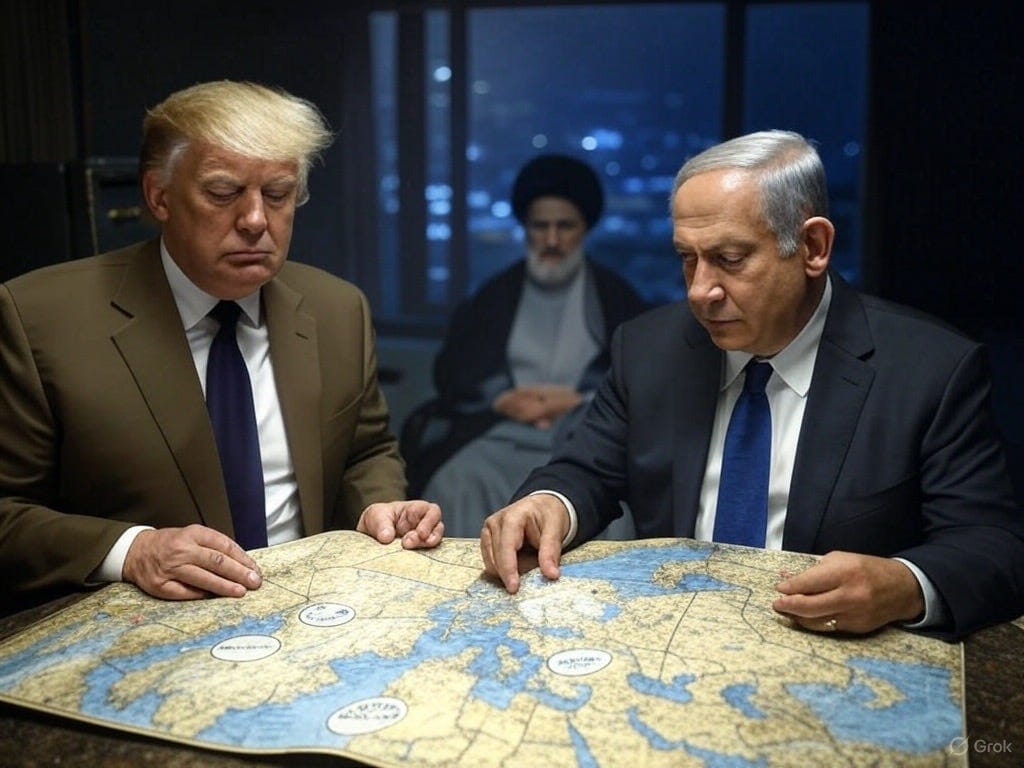
Restrainers in Washington are issuing harsh warnings towards the Trump administration and the American public about engaging in a direct attack on Iran’s nuclear facilities, or allowing the Israelis to do so. They say it would lead to similar outcomes to the Iraq War, which the majority of Americans have a very unfavorable views towards, but these restraint-oriented pundits are wrong.
A strike on Iran’s nuclear facilities, whether done by the US, the Israelis, or a coalition of partners, will be a short, successful operation that will not impart the burdens that the Iraq war did to the US. Should negotiations between the Iranian Regime and the Trump administration go south or stall, it is within our interests to engage in or allow a strike on Iran’s nuclear facilities to occur, and such an attack would put the US and our partners in a better position moving forward.
Restraint-oriented types are smart to frame a possible attack on Iran as similar to Iraq, as Americans generally view the Iraq War and US involvement in Middle Eastern conflicts unfavorably. According to Pew Research, the majority of Americans and Iraq War veterans viewed the Iraq war unfavorably in 2019.

Those dovish on the possibility of Iranian strikes will also notice the justification for these strikes can sound eerily similar to the lead up to the Iraq war—talks about WMDs and state-sponsored terrorism in Iraq lead to a full-scale ground invasion which resulted in a war meant to change the Baathist Saddam Heussein regime to a democracy, and years of “nation-building” that many of these types believe was meant to line prominent Neocons in Washington’s pockets. They’ll be comforted to know that in this case, we’re not relying on potentially-corrupted, deep-state intelligence to make the case to mount a full-scale invasion.
In the case of Iran, the International Atomic Energy Agency, an independent agency which inspects many nuclear sites worldwide, has inspected some of Iran’s nuclear sites in recent weeks and has determined that they’re not only close to a bomb, but they’re increasing uranium production.

There’s also no indication the US administration or the Israelis are looking to change the Iranian regime, or even mount a ground invasion. There’s a lot of evidence to the contrary. The strikes being discussed are limited strikes on Iran’s nuclear facilities, as mapped out by the Financial Times below, all of which can be struck by planes that both the Israelis and the US Air Force have.
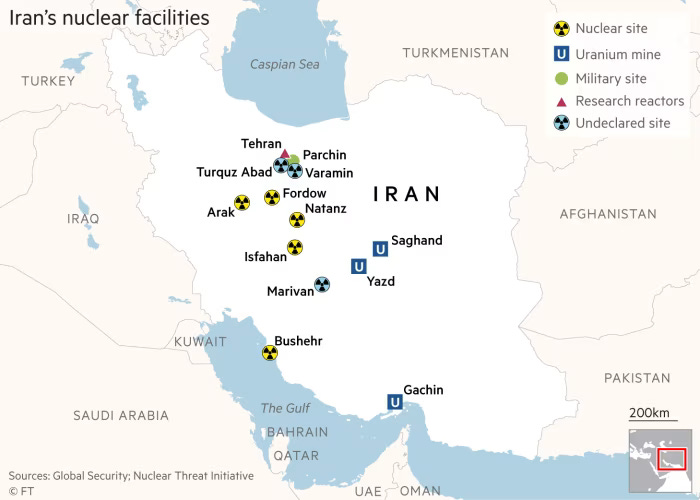
While there’s risk involved with engaging in these strikes, it is nowhere near as costly in terms of lives of our troops or taxpayer dollars as a ground invasion. If there were to be some type of limited incursion (which would be challenging, as Iran is surrounded on all sides by either water, mountains, or desert), it would likely not rise to the levels of failure we saw in the Iraq war.
American public opinion really turned on the Iraq war during the counter-insurgency in Iraq, not the initial invasion. This is because of bad decisions made by the Bush administration once the Iraqis surrendered. We fired every member of the Iraqi police force and their military, leaving tens of thousands of military-aged males without pay-checks and pensions, and gave them a lot of free time. Many joined Al Qaeda after their job loss, and began fighting in an insurgency, which is when the majority of American troops began losing their lives in ambushes around Iraq. This was a grave mistake made by the Bush administration which our security establishment has never really accounted for or apologized for, and is the reason most Americans identify as war-weary, especially when it comes to the Middle East.
The good news is that while the American people often can’t look at the Iraq war with this level of nuance, our security establishment can, and they will never make a similar mistake. We know this because they advise allied countries not to make this mistake—we can find proof of this with our Lebanon policy, where the US has seemingly notified the new President of Lebanon, Joseph Aoun, to pursue talks with Hezbollah defense officials to merge the Lebanese Armed Forces with Hezbollah’s militia forces, to prevent former members of Hezbollah from engaging in a similar insurgency.
And by the way, while Americans are war-weary in the Middle East, broadly speaking, Americans are actually pretty supportive of short, quick, American-lead airstrike campaigns. FDD’s Bill Roggio has an interesting analogy to explain this phenomenon Americans feel:
“I call it McWar. We want to pull through the drive through, order our war, get out, chomp on it in the car, throw the wrapper out the window, and drive home all happy and fun. Meanwhile, our enemies are going to the gourmet restaurant, ordering the seven-course meal. They’re in it for the long-haul, and we’re wanting the fast-food option for these wars.” -Bill Roggio, Editor of FDD’s Long War Journal
We see evidence of Roggio’s “McWar” theory in US public opinion on short, quick airstrike campaigns—71% of Americans support President Trump’s strikes on the Houthis in Yemen according to Harvard-Harris. When Trump struck Assad regime targets in April 2017 in his first term, he saw similar approval numbers, and he drew praise from a surprising source—the mainstream media. CNN’s Fareed Zakaria referred to the night Trump ordered those strikes as the night Trump “became President”, praising the move. NBC’s Brian Williams called the strikes beautiful, quoting poet Leonard Cohen, saying on air “I am guided by the beauty of our weapons.” Strike plans on Iranian nuclear sites would likely see similar approval numbers, being that the strikes would likely only last a few nights to a few days, and there is no appetite, nor plans, for a ground invasion.
So criticism of potential strikes on Iranian nuclear sites because they would be unpopular with Trump’s base and the American public at large, or because they could lead to a second Iraq war (and subsequent failure), are largely criticisms without base. There are better arguments against these strikes— the Israelis would need a lot of help from the US, and concerns about retaliation from Iran and their allies.
The possibility of a joint American/Israeli attack is often criticized because it’s thought that the US would have to do the heavy lifting in that strike when it would benefit the Israelis more than it would benefit the US. The US has B-2 bombers that can carry heavy bombs long distances to strike the nuclear facilities deep under mountains in Natanz and Fordo that the Israelis don’t have, for instance. While Israel does not have the conventional military strength that the US has, we have seen evidence of their creativity. Experts told us for years that a war between Israel and Hezbollah could be the deadliest war the world sees in our lifetimes because of the heavy firepower and willingness to fight between the two, but Israel planned for this attack and came up with their pager and radio plan where they infiltrated Hezbollah’s supply chain and sold them electronics rigged with explosives that were carried by prominent members of Hezbollah’s militant wing. This made for a conflict between the two actors, which came to a head in September 2024, which was much more tame than anyone could have anticipated. While Israel underestimated Hamas and their capabilities, they were always prepared for Hezbollah, and the Israelis are more concerned about the Iranian Regime than Hezbollah. I can’t be sure, but I believe it’s safe to assume the Israelis have devised a similarly-creative plan in the case they have to take out Iran’s nuclear program without the help of the US. And for what it’s worth, the US doesn’t have to help in actually bombing these sites, we could also just help the Israelis with mid-air refueling or allow them to use our aircraft carriers in the Persian Gulf.

Finally, there’s the concern about retaliation from the Iranian Regime and its allies, namely Russia and China. These concerns are largely over-stated and unfounded, in my opinion. In terms of a retaliation from the Iranian Regime themselves, their proxies are largely gutted, and the Israelis struck their ballistic missile factories in their latest strike on Iran in the summer of 2024, so the Iranians would be using up weapons they cannot quickly resupply should they choose to respond. We shouldn’t assume they’ll choose to respond—actually, we have a long list of examples of the Iranians choosing not to respond when the regime itself was hit. When Trump struck Qassem Soulemani in January 2020, the same people who are now expressing concerns about a WW3 scenario warned the same things back then, but the Iranians only hit a handful of US bases and they warned us in advance. When the US took out Iran’s entire Navy in Operation Praying Mantis under Reagan, there was a similar outcome.
So the Iranians are unlikely to respond if their program is taken out, which leaves Russia and China to respond on their behalf. While the Iranian Regime has taken part in joint exercises with the Russians and the Chinese, it is laughable to think either party would mount a significant attack on behalf of the Iranians and their nuclear program. The Russians were recently chased out of Syria with their tail tucked between their legs by a former Al Qaeda offshoot that is armed by the Turks. If Russia left Syria that easily, and continues to be busy with Ukraine, they don’t have the bandwidth to mount a large attack on behalf of the Iranians. As for the Chinese, it would break longstanding precedent for them to engage in hostilities with the US on behalf of an ally. While the Chinese are building up a navy that is clearly meant to roam worldwide, it isn’t ready yet, and the Chinese are likely saving this firepower for where it is currently concentrated—the Indo-Pacific. It is extremely unlikely that the Chinese enter this conflict on behalf of the Iranian Regime and mount a counter-offensive as well. The most likely outcome is that the Iranian Regime and its allies do nothing in response to the nuclear program being taken out, or if anything, a limited ballistic missile attack on Israel, which Israel has underwent twice before. If this happens, the US has provided a second THAAD missile to the Israelis to help intercept a potential attack.
While there is a low likelihood of the Iranians and their counterparts widening the conflict, as well as a low likelihood that a potential strike on Iran turns into the Iraq War 2.0, there is still uneasiness in the US in regards to a potential strike on Iran. This uneasiness comes from restrainers’ discomfort with starting new wars, so they should realize that not striking Iran’s nuclear facilities does not prevent new wars. In fact, if the Iranians are able to obtain a nuclear bomb, they may very well start new wars, feeling their nuclear program gives them the ultimate insurance policy.
Should Iran get a nuclear bomb, and start developing warheads that could carry those bombs places, it is likely we see a nuclear arms race in the Middle East. Countries like Saudi Arabia, Turkey, the UAE, and Egypt are likely to try to obtain a nuclear bomb in order to deter the Iranians from striking them, like China chose to pursue a nuclear program after the Soviet Union and the US got nuclear bombs. If the US does not want a nuclear arms race among our allies in the region—and other countries that may want to restrict Iranian influence in their countries, like Iraq and the new Syrian regime—we will have to give these countries assurances that we will act on their behalf if the Iranians become hostile towards them once they have a nuclear bomb. Being that it is the US’ stated intentions to get out of the Middle East and stop intervening in regional conflicts there and instead focus on Asia, it would be counter-intuitive to allow the Iranian regime to get a nuclear bomb.
Unfortunately for restrainers, there is no solution to completely end wars in the Middle East. They are wrong to believe that the US creates all conflicts in the Middle East, and that we could solve all Middle Eastern conflicts by simply leaving, and letting actors like the Iranian regime, the largest state-sponsor of terror in the world, to do as they please. If we want peace in the Middle East and the broader world, we need to maintain relationships with allies who can project power outside of their borders and let them dictate what happens in their regions, and give support when necessary, if we have the bandwidth and excess weapons to sell to them, and they have exhausted their options otherwise (we should be the last line of defense, not the first). A great step towards this practice would be aiding the Israelis in striking the Iranian nuclear facilities, facilitating a peace agreement between Israel and Saudi Arabia (and hopefully Turkey), and then drawing down our deployments to the Middle East to let these allies run their region as they see fit.
Amanda Peterson, guest author, is a commentator who majored in Religious Studies with a concentration in the Abrahamic Faiths at the University of Minnesota-Twin Cities. She speaks to an audience of 28,000 on TikTok, as well as on Twitter, YouTube, Substack, and on her True Crime podcast Don't Waste This F*cking Podcast, which covers fraud schemes.