The Irish Problem with Israel
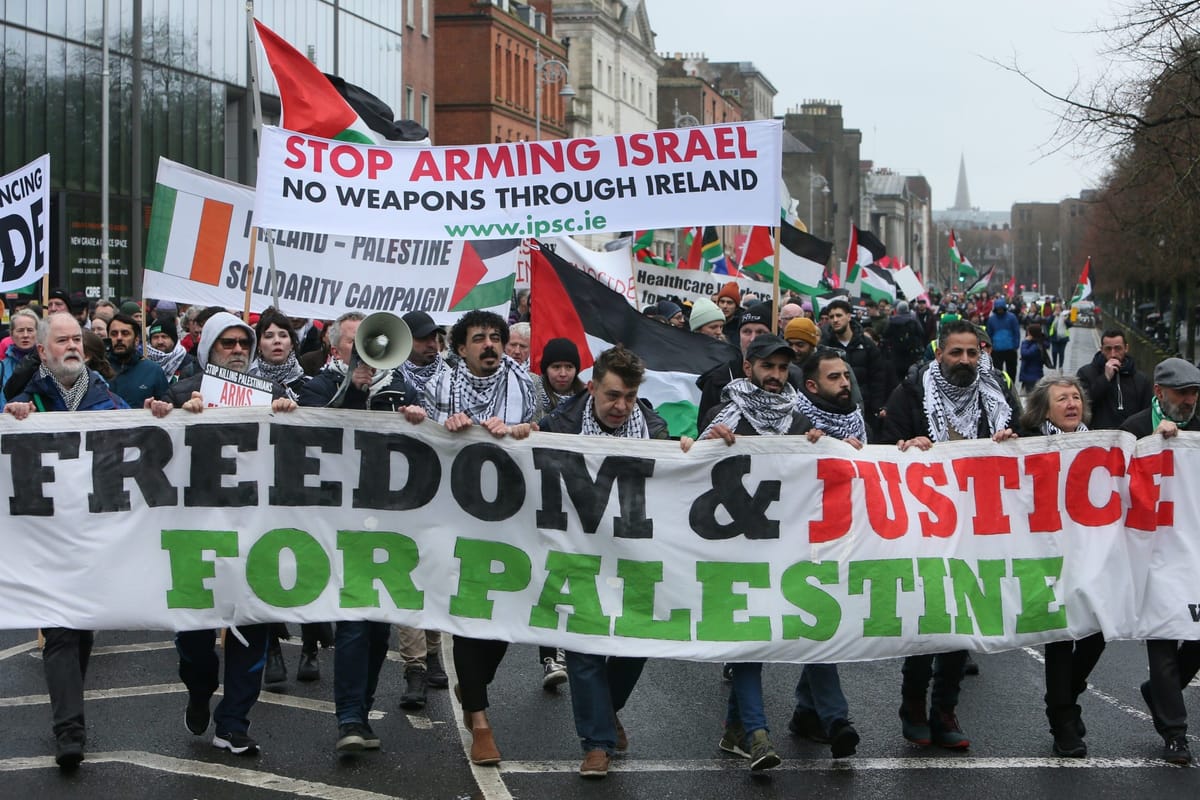
Irish resentment towards Israel has been brewing for some while, but reached a peak of sorts a few years ago with the announcement by Irish author Sally Rooney, that, in solidarity with the Palestinian ‘cause’, she was rejecting her Israeli Publishers offer to publish her latest book in Hebrew.
Now the Irish attitude to Israel and Jews in general is a subject I’m something of an expert on, with my mother being Irish-Catholic and my father Jewish.
So, for much of my life, I had a ringside seat on domestic interaction between the Irish and Jews, if you will. Both my parents were avid supporters of Israel, as it turns out, but my mother carried this flame even long after my father’s early death. She was among a cheering audience watching ‘Fiddler on the Roof’ when its star Topol announced he was off to fight in the 1967 war, visited Israel for a second time only weeks after the war was over, and had a framed photo of Moishe Dayan on her bedroom wall.
A number of Irish now would no doubt claim that my mother was an exception, but that would be far from the truth. Indeed, both the Irish pro-Israel and pro-Palestinian stances stem from the fact that they see in those conflicts a reflection of their own struggle against British rule. They were also well aware, even well before the holocaust that, like them, Jews had suffered extreme prejudice, as evidenced by that oft-seen boarding house notice between the 1920's and 1960's, 'No Blacks, no Jews, no Irish.'
Indeed, the struggles of early Jews/Zionists were also against the British to finally form Israel, which is why at that stage the Irish were fully supportive of Israel. Their struggle stood on all fours with the Israeli struggle.
Even after the 1948 war and the formation of Israel, Irish support remained strong for Israel. In their view, British Imperialism/Colonialism had merely been replaced with pan-Arab Colonialism, with a small, beleaguered nation, Israel, formed from a rag-tag bunch of refugees, surrounded by much larger, powerful nations – Egypt, Jordan, Syria, Iraq, Lebanon – all vying for its destruction. So, what changed?
The first part of that shift in fact came with the 1967 war; lasting only six days, it seemed that Israel was not as weak and defenceless as first thought. But the main part came with the shift from pan-Arabism – in the wake of peace deals signed with Egypt and Jordan – with the Palestinians then viewed as a separate, more isolated people. Propaganda with the rise of Yasser Arafat’s PLO added impetus, who indeed likened his cause to that of the IRA.
Although with the way that the Palestinian ‘cause’ was pursued through this period, with massacring Olympic athletes, plane hi-jackings, and blowing apart women and children in cafes and on buses, still very few Irish supported the Palestinians, perhaps just a 20% margin of hardline IRA supporters – the majority of Irish sympathy rested with Israel.
Arafat in fact came out with the proclamation, ‘If we make life insufferable for the Jews, they will leave in droves.’ Hamas too later followed this early Fatah/PLO lead, with a wave of suicide bombings which, at its height, saw as many as three bombings a month.
But these plans backfired.
Israel constructed a series of security barriers and increased checkpoints for safety. And it was only at this point that Irish sympathies started to shift towards the Palestinians. The divide was quickly dubbed ‘apartheid’ – even though clearly evident that if its purpose was ‘racial’, it would have been constructed 40 years previous, not in the wake of one of the worst waves of suicide bombings that any nation has suffered. And on the back of this, other demonizing terms quickly followed: occupation, ethnic cleansing, they ‘stole’ our land, and finally the BDS movement – Boycotts, Sanctions and Divestment. It’s in fact BDS which Sally Rooney cited as her main ‘umbrella cause’ for not accepting an Israeli-Hebrew publication of her last book.
But the post 1967 period saw an extra boost in Irish alliances with the Palestinians, though from an unlikely source: Russia. Moscow’s KGB grooming of Yasser Arafat in that period endeared him and the Palestinian ‘cause’ not only more with the Irish, but also with the left-wing and any self-respecting 'freedom fighters’.
Right after the 1967 Six Day Arab-Israeli war, Moscow got him appointed to chairman of the PLO, then in 1969, the KGB asked Arafat to declare war on American "imperial-Zionism" - a Moscow invention and a long favoured tool of Russian intelligence to foment ethnic hatred. The KGB always regarded anti-Semitism plus anti-imperialism as a rich source of anti-Americanism, with the source of that 'grooming' of Arafat in fact going back many years.
Originally from a well-to-do Egyptian family, part of this grooming to become the future PLO leader was through the KGB destroying the official records of Arafat's birth in Cairo, replacing them with fictitious documents saying that he had been born in Jerusalem and was therefore a Palestinian by birth.
Throughout this period, Arafat had also forged close ties with the IRA, with al-Fatah as far back as the 1970s organizing arms and terrorist training for IRA operatives in Libya and Lebanon. This alliance and support ran deep, with in 2006 Sinn Fein's Aengus O'Snodaigh summing it up by describing Israel as 'without doubt one of the most abhorrent and despicable regimes on the planet.' And Gerry Adams later became one of the most vocal supporters of economic sanctions against Israel with BDS. So, the initial alignment between Ireland and the Palestinians was between its terror groups and 'freedom fighters' rather than the Irish people. Which goes a long way to explaining why Palestinian support is stronger among the young and university students, not only in Ireland, but elsewhere - still filled with idealism and a benign view of ‘freedom fighters’ – than the older generation.
But Irish PM, Simon Harris, having over the years shown strong support for Palestinians, including a recent approval for a Palestinian State - and equally condemning of Israel’s actions in Gaza – suddenly found himself taking a step back on any commitment to take in Palestinian refugees. Because while generally the Irish have shown support for the Palestinians, there’s a reluctance to take in extra refugees from any nation.
Only eighteen months ago there was a mass riot in Dublin following the stabbing of three young girls – though thankfully no deaths - by a naturalized-refugee originally from Algeria. Immigration has subsequently become a key political issue in Ireland, and Harris feared that if he let in a large number of Palestinian refugees, Ireland would swing more to the right and he’d lose the next election. As one journalist succinctly put it, ‘He might love Palestinians, but obviously not enough to offer them a safe haven in Ireland.’ Meanwhile, with no official policy for refugee accommodation, even temporarily in hotels, Ireland remains one of the few places in Europe where refugees are housed in tents on the street, including the 129 Palestinian refugees arrived this past year – five times the number from the previous year.
Meanwhile, the issue of Palestinian refugees has become something of a political football, with Israel’s Defence Minister, Israel Katz, asserting that those who have condemned Israel’s actions in Gaza and recently announced their support for Palestinian Statehood – Ireland, Spain and Norway – should take in a large number of refugees. ‘To not do so would appear hypocritical.’
But while Irish PM Harris might castigate Israel’s actions against Hamas in Gaza, he has a lesson right on his own doorstep, if he paid attention. Rather than discard that mass riot in Dublin over the stabbing of those three young girls as just ‘fringe extremists’, a riot of such size was obviously representative of a significant sector of the Irish public. And while being anti-immigration, most would also be anti-Islamic-extremist, and so likely pro-Israel as well.
But rather than just three wounded young girls, just imagine what the Irish reaction would be to the massacre of 1,200 of its own in cold blood, including 300 young people at a music festival and the butchering of whole families, including infants and babies? It’s not difficult to imagine that the riots would have been tenfold and would likely have continued until every last terrorist-murderer was killed or dragged away and arrested by the police for their own safety. So, in a way, stark hypocrisy is evident even before Harris has spurned Palestinian refugees.
Certainly, on the face of it, Ireland ticks all the right boxes as a prime anti-Israel advocate. They were one of the first nations to endorse BDS, object to barriers and security fences – which they were quick to dub ‘apartheid’ divides, despite their obvious security designation – and opposed West-Bank-Judea-Samaria settlements. But underneath these official lines, strong pockets of support for Israel remain in Ireland, particularly among the over 40’s and older generation.
This came to light in particular when Israel scored 10 points from Ireland’s public vote in the recent Eurovision song contest – the second highest possible score. Both the Irish and Spanish PMs have called for an investigation into the voting, feeling it was out of step with public opinion in their nations. Whereas opposing voices feel it’s because there’s ‘a serious divorce between Irish public opinion and the prevailing national narrative’ about Israel, according to Daniel O'Dowd, a spokesman for ‘Ireland-Israel Alliance’.
This wouldn’t be the first time that prevailing visible opinions have been out of step with actual public opinion. View the weekly ‘Palestinian support/anti-Israel’ marches in London, and you’d gain the impression that it was representative of most of the nation. Yet when polls were taken on whether the public agreed with the marches and their sentiment, 68% were against on a Sky News poll, and 74% against on a GB News poll.
A similar trend could be seen when Jeremy Corbyn was running to be British PM in 2019. View the massive support he had with street marches and at Glastonbury, or similarly online, and you’d become convinced he was about to win. Yet he lost by a landslide. Reason being, students and young people have far more visibility at concerts, on marches and online. But there’s a massive, mostly silent, majority of over 35-year-olds, who have far less presence at those, yet take part in critical votes. So, it could well be that an official Irish national line – particularly from a left-wing government – combined with a strong and vocal youth online, is not fully representative of overall Irish public opinion.
Paradoxically, if Ireland did open itself up to stronger immigration, and as a result suffered the same Jihadist-led violence suffered by other European nations such as France, Germany and mainland UK, they might come to realize that many of them are cut from the same cloth as Palestinian terrorists, and sympathy and accord with Israel would rise.
But it would be wrong to wish that on the Irish people. Even though their current government, in supporting a Palestinian State – when after Oct 7th it should be patently clear to anyone with 20/20 vision that it would be no more than a terrorist State – seem perfectly happy to wish more of the same on Israel.
John Matthews is an experienced writer and journalist. The author of 24 books, including two centred around WW2 and the holocaust in the name of J.C. Maetis (his father’s original Jewish name) his first experience of writing about the Middle East came as a war correspondent covering the last years of the Lebanese Civil War, which led to his second book, ‘The Crescents of the Moon’. Follow him on Substack, where he is offering a FREE book to all new subscribers: Past Imperfect, an intense groundbreaking crime thriller set between England, France and the USA, exploring the link between two young boys thirty years apart.