The Last Time America Had a ‘Double President’

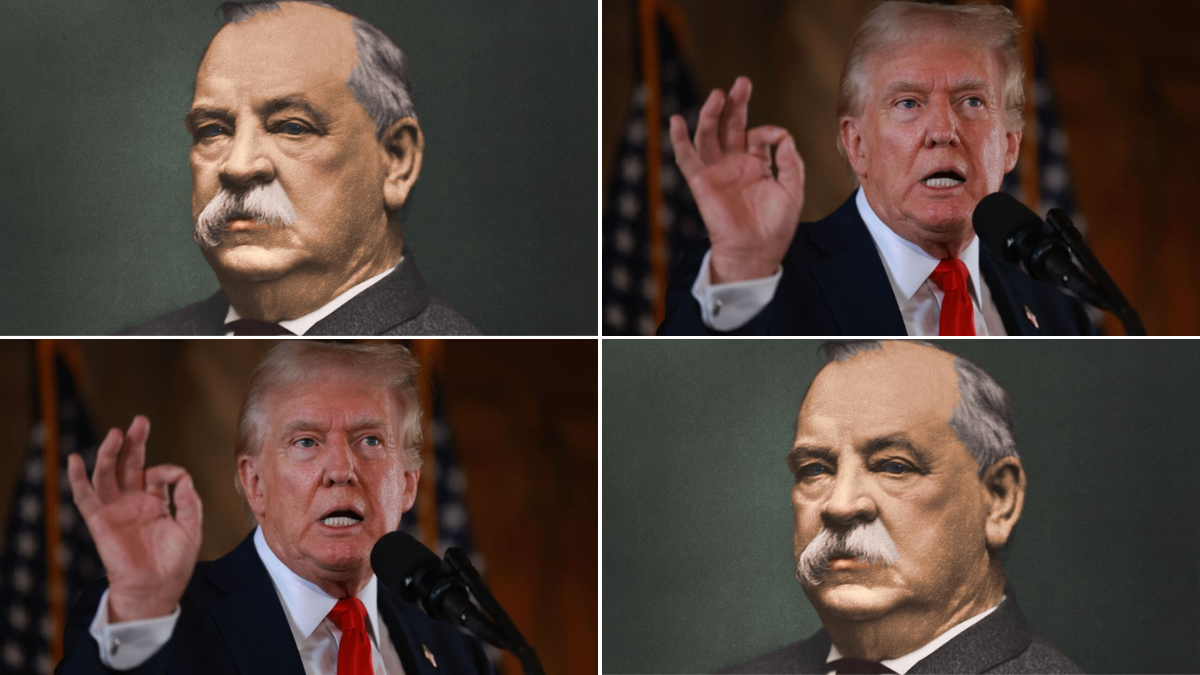
On November 5, 2024, Donald J. Trump made history by becoming the first president in over a century to win a second, non-consecutive term in office. While this achievement is rare, it is not without precedent. Grover Cleveland, the 22nd and 24th president of the United States, was the first—and until now, the only—man to pull off this feat. His split presidencies offer a fascinating lens through which to view the challenges and opportunities of returning to the White House after an electoral defeat. Cleveland’s unique place in history, along with the similarities between his political journey and Trump’s, provides valuable insights into what it means to serve as a “double president.” While their times and temperaments differ greatly, both men share traits that help explain their ability to stage remarkable comebacks and navigate the turbulent waters of American politics.
Grover Cleveland, born in 1837 in Caldwell, New Jersey, was a lawyer and politician known for his honesty, independence, and no-nonsense approach to governance. Like Donald Trump, Cleveland had close associations with New York, the state that defined his political ascent. After moving to Buffalo in his youth, Cleveland became mayor and subsequently governor of New York, earning a reputation as a reformer who fought corruption and prioritized integrity over partisanship. Similarly, Trump’s upbringing in Queens and his real estate career in Manhattan positioned him as a figure who understood both New York’s gritty streets as well as its halls of power. Both men carried their New York ethos into national politics: a blunt, pragmatic style that resonated with voters seeking authenticity.
In 1884, Cleveland ran for president as a Democrat, a party that had not had success in reaching the White House in some time. It was regarded as one of the “dirtiest” elections in U.S. history. Cleveland’s campaign attempted to emphasize his integrity and position him in stark contrast to the scandals of his Republican opponent, James G. Blaine. However, Cleveland’s campaign was not without controversy. He faced allegations of fathering an illegitimate child with a woman named Maria Halpin. Cleveland acknowledged responsibility for the child, providing financial support and arranging for care, but the historical record is somewhat ambiguous. Halpin had relationships with multiple men at the time, including some of Cleveland’s married friends, and some historians speculate Cleveland accepted responsibility in order to protect them. Despite the uncertainty, the scandal became a significant issue during the election, with Cleveland’s opponents chanting, “Ma, Ma, where’s my Pa?” After Cleveland’s victory, his supporters gleefully refrained, “Gone to the White House, ha ha ha!”
Cleveland narrowly won the election, becoming the first Democratic president since James Buchanan (the reason this is complicated is due to Andrew Johnson’s presidency, who some may argue was a “Democratic” president, for all intents and purposes). His first term was characterized by his unwavering commitment to reform and fiscal conservatism. He vetoed an unprecedented number of congressional bills (more than all of his predecessors combined), refusing to yield to party bosses or special interests. His opposition to Civil War pensions for veterans he believed were ineligible and his resistance to high tariffs alienated certain segments of the electorate but cemented his reputation as a principled leader. Cleveland’s independent streak often put him at odds with members of his own party, a trait he shared with Trump. While Cleveland’s battles centered on fiscal discipline and curbing patronage systems, Trump’s clashes with establishment Republicans have revolved around his outsider approach and challenges to long-standing party orthodoxy. Both men demonstrated a willingness to defy their parties when they believed it served the greater good.
Cleveland’s administration also reflected his belief in limited-interventionist policies, particularly in foreign affairs. He opposed expansionist tendencies, including rejecting the annexation of Hawaii, arguing that such actions violated American principles. In fact, he viewed the overthrow of Queen Liliuokalani as an illegal act of war and withdrew military support, seeking her restoration. Trump similarly championed a non-interventionist approach during his first term, frequently criticizing U.S. involvement in “endless wars” and advocating for an “America First” foreign policy. While Cleveland’s restrained approach to foreign entanglements was less controversial in his time, Trump’s similar stance has sparked intense debate in an era of global interconnectedness and leviathan military interests.
In 1888, Cleveland lost his reelection bid to Benjamin Harrison despite winning the popular vote, even losing his home state of New York. The Electoral College, swayed by strong Republican support in swing states, handed the presidency to Harrison. Cleveland returned to private life in New York, where he practiced law and waited for an opportunity to reclaim his political standing. Four years later, public dissatisfaction with Harrison’s administration and growing economic unrest provided an opening for Cleveland’s return. Running on a message of continuity and stability, Cleveland decisively won both the popular vote and the Electoral College in 1892, becoming the first—and until a few weeks ago, only—president to serve two non-consecutive terms.
Cleveland’s second term, however, proved to be more challenging than his first. Shortly after his inauguration, the nation plunged into the Panic of 1893, one of the worst economic depressions in U.S. history. Cleveland’s response to the crisis—defending the gold standard and opposing inflationary policies like the free coinage of silver—alienated much of his Democratic base, especially agrarian populists in the South and West. The economic turmoil led to widespread strikes, including the infamous Pullman Strike, which saw federal troops deployed to quell unrest. Cleveland’s second term was defined by political isolation and growing discontent, and when he left office in 1897, he did so under a cloud of unpopularity. Nevertheless, Cleveland’s legacy endures as a testament to his steadfast commitment to principles, even in the face of adverse political conditions.
While Cleveland and Trump share traits as reformers and outsiders, their personal lives reflect interesting parallels and contrasts. Cleveland entered the presidency as a bachelor and, in 1886, became the first president to marry while in the White House (Wilson would also do so in 1915, but as a widower). His bride, Frances Folsom, was 27 years his junior, and their unconventional romance captivated the public. Trump, too, has drawn attention to his personal life, and Melania Trump is, similarly, 24 years his junior. Cleveland was also an avid outdoorsman who loved fishing and hunting, finding solace in nature amid the pressures of Washington. Trump, by contrast, is passionate about golf, a hobby that has served as both a personal retreat and a business interest. These pastimes reflect their respective eras and personalities: Cleveland’s love of quiet, remote spaces mirrored his reserved demeanor, while Trump’s flair for the spotlight fits with his use of golf courses as gathering places for power and influence.
While Trump’s first term was marked by significant accomplishments and controversy, his second term begins under a very different set of circumstances. Unlike Cleveland, who faced economic disaster upon his return to office, Trump takes over during a period of relative recovery following the challenges of COVID-19 and inflationary pressures. However, the potential for economic uncertainty remains, as Trump will need to navigate issues such as the national debt, global instability, and illegal immigration. His success will depend on his ability to adapt to evolving challenges while fulfilling the promises that helped sweep him back into power.
The phenomenon of the ‘double president’ is exceptionally rare in American history, reflecting the unique flexibility of the political system and the willingness of voters to reevaluate a leader’s suitability for office in changing times. Cleveland’s journey from victory to defeat and back again demonstrates that the presidency is not just about attaining power—it’s about proving one’s leadership and earning the trust of the people anew. For Donald Trump, the road ahead is sure to be challenging, as he navigates the expectations of a divided nation and the weight of his own legacy.
As Trump prepares to reenter the Oval Office, comparisons to Cleveland provide an opportunity to reflect on the cyclical nature of American politics. The presidency, after all, is not defined by the man who holds it but by the enduring values of the republic it serves. In this moment of political upheaval, the lessons of Grover Cleveland’s experience remind us of the challenges and possibilities that come with a second chance at leadership. Whether Trump’s presidency will echo Cleveland’s struggles or chart a new course entirely remains to be seen, but the rarity of this historical feat ensures it will be closely watched—and long remembered.
Michael J. Hout is the Editor of Liberty Affair. He currently resides in Warsaw, Poland. Follow him on X: @michaeljhout