Today, Canadians Choose Between Conservative Resurgence and Liberal Continuity

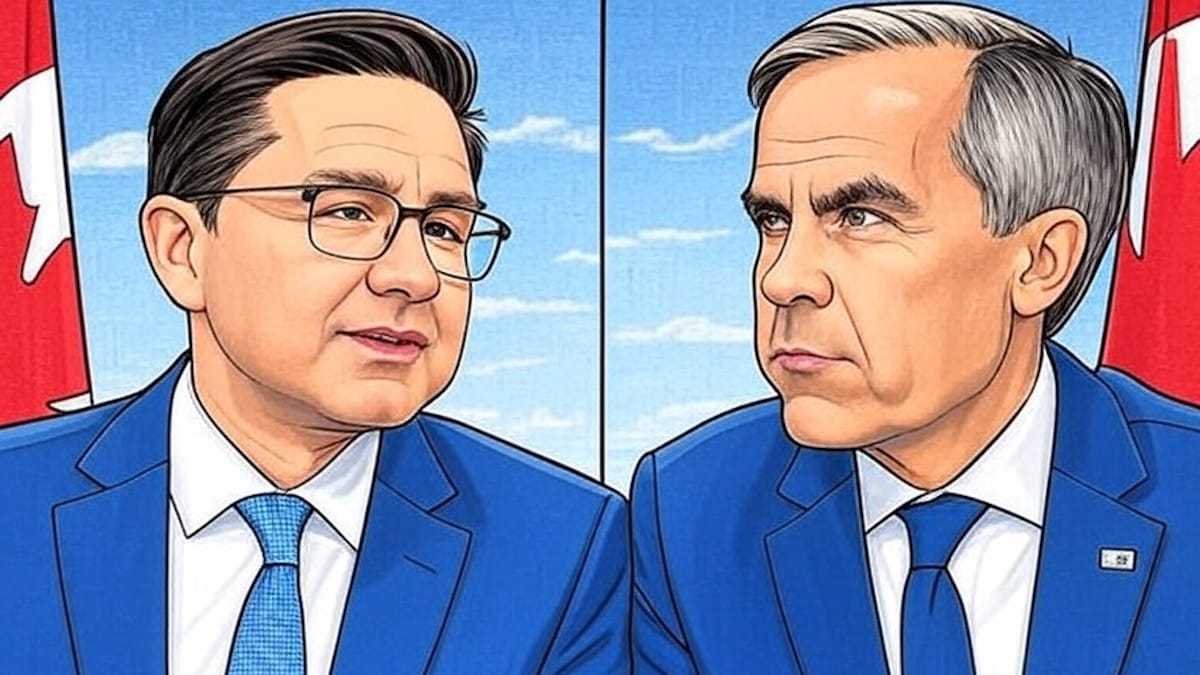
Today, Canadians head to the polls in what many are calling the most consequential election in a generation — a decision that will not only determine the country’s economic direction but also its political identity amid growing global uncertainty.
After nearly a decade of Liberal rule, Canada finds itself at a crossroads. Years of soaring living costs, rising crime, strained healthcare, and economic stagnation have fueled widespread frustration among voters. Once envied for its stability and prosperity, Canada now wrestles with problems that many believe are the direct legacy of the Trudeau era.
Leading the charge for change is Conservative Party leader Pierre Poilievre, who has spent the past three years sharpening a message of economic renewal, national strength, and individual freedom. Poilievre has presented himself as the antidote to a decade of mismanagement — a leader willing to dismantle the bureaucracy, unleash Canada’s natural resources, tackle crime head-on, and defend Canadian sovereignty against an increasingly aggressive global environment.
His opponent, Liberal Party leader and current Prime Minister Mark Carney, offers a very different vision: one of steady, technocratic leadership grounded in his deep experience as a former central banker and international executive. Carney’s supporters argue that he is the steady hand Canada needs in turbulent times, despite being closely tied to the same Liberal establishment many Canadians blame for the country’s decline.
A Nation at a Breaking Point
Polls show that affordability is by far the top issue on voters’ minds. Housing prices have soared beyond the reach of average Canadians, especially in urban centers. Rent, mortgages, groceries, and energy costs have stretched household budgets to the breaking point. Poilievre has proposed aggressive deregulation to speed up housing construction, aiming to unleash private sector growth. Carney, meanwhile, has suggested more government financing programs to stimulate the building sector — a familiar approach that critics say has already failed to rein in skyrocketing prices.
Compounding domestic anxieties is the growing external pressure from America’s evolving trade policies. President Donald Trump’s reimposition of tariffs on Canadian goods and his increasingly blunt rhetoric about absorbing Canada into the United States have shocked many north of the border. While both Carney and Poilievre have vowed to push back diplomatically and economically, Poilievre has kept his distance from making Trump the centerpiece of his campaign, wary of alienating conservative voters who may admire Trump’s hard-nosed leadership style.
Carney, by contrast, has leaned into anti-Trump rhetoric, attempting to position himself as the more combative figure willing to stand up to Washington. Yet for many Canadians — and for conservatives especially — Carney’s elite credentials and polished internationalist persona ring hollow when compared to the grit and realism demanded by today’s challenges.
Competing Visions for Canada’s Future
The sharpest contrast between the two candidates lies not just in their policies but in their worldviews.
Poilievre has embraced a populist tone, promising to shrink the size of government, lower taxes, crack down on crime, support Canada’s vital oil and gas industries, and eliminate what he calls the “radical woke ideology” that has seeped into Canadian institutions. His emphasis on restoring common sense and national pride resonates with Canadians who feel alienated by the Liberal Party’s focus on globalism, climate evangelism, and progressive social policies.
Carney offers the polished, managerial alternative. He has pledged to fine-tune rather than overhaul Canada’s social and economic systems, arguing that technocratic competence and global cooperation are the keys to success. Critics, however, see him as simply offering more of the same policies that have failed to tackle the crises now facing ordinary Canadians.
On critical issues like immigration, crime, and addiction, both candidates acknowledge problems but diverge in their solutions. Poilievre has proposed a tougher immigration system, harsher penalties for repeat offenders, and involuntary treatment for addiction and mental health crises. Carney, while admitting the need for reform, has shied away from endorsing stronger enforcement, instead emphasizing more funding and systemic reviews.
On energy, Poilievre has called for the aggressive expansion of oil, gas, and mineral development — a sharp contrast to the Liberal Party’s record of environmental regulations and project cancellations. Even Carney, despite his past advocacy for green finance, has moderated his stance during the campaign, recognizing the economic need to unlock Canada’s natural resource potential. But for many voters in energy-producing provinces, it is Poilievre’s full-throated defense of pipelines and industry that offers the clearest path back to prosperity.
A New Political Landscape?
Today’s election is not just about leadership; it is about what kind of country Canada wants to be.
Will Canadians choose the path of cautious internationalism and managed decline, continuing the Trudeau legacy under a new face? Or will they embrace a bold, unapologetic effort to restore national resilience and economic sovereignty under a Conservative banner?
For conservatives in Canada — and for Americans watching closely — this election signals whether the populist wave that reshaped politics south of the border will find a home in America’s northern neighbor.
If Poilievre succeeds, it could mark the beginning of a political realignment in Canada, where voters who once saw conservatism as a relic of the past now see it as the only viable solution for a future worth fighting for.
Michael J. Hout is Editor-in-Chief of Liberty Affair. Based in Warsaw, Poland, he writes about politics, culture, and history. Follow his latest insights on X: @michaeljhout.