Trump’s Inauguration Marks a Paradigm Shift in American Power
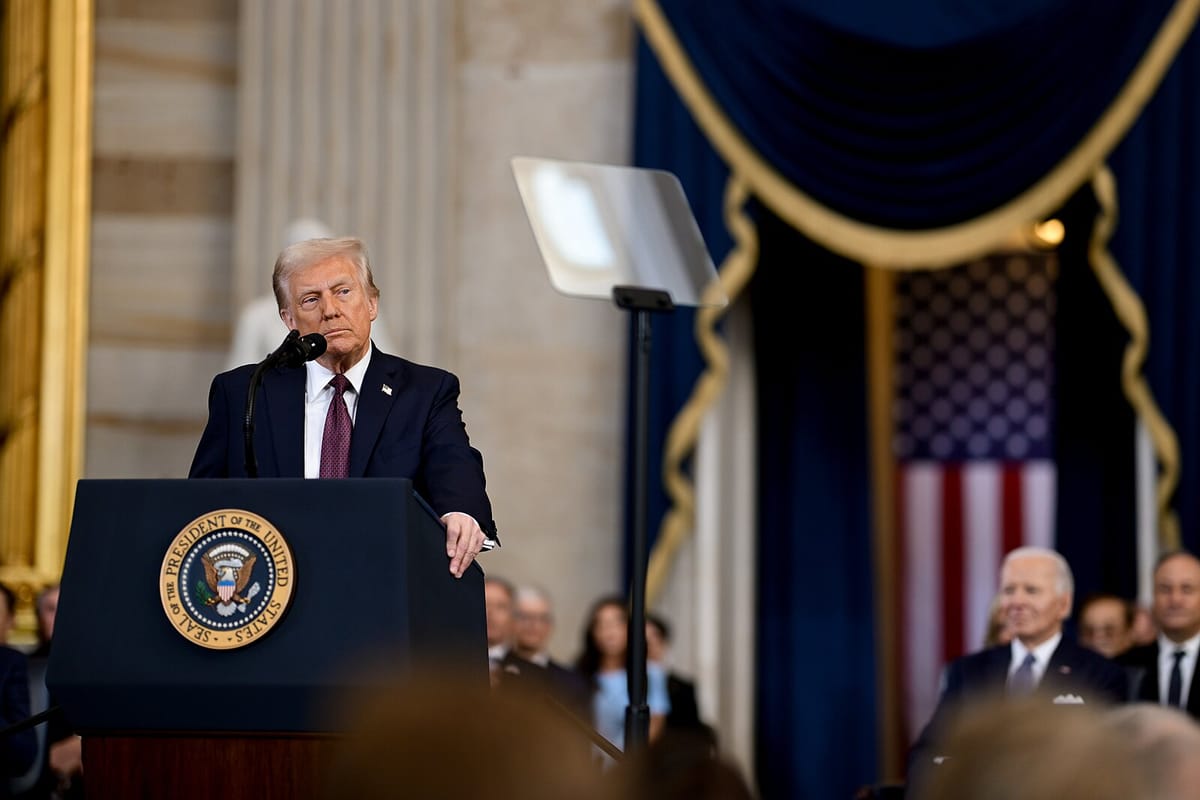
During his recent inaugural address, the newly-reelected President Trump touched upon profound and historically resonant themes, such as Manifest Destiny, while setting his sights on the conquest of Mars. By invoking these themes, he signaled a renewed commitment to American expansionism—both terrestrial and extraterrestrial—that challenges the stagnation of recent decades. He also delved into the story of the Panama Canal, a project completed in 1914 with substantial American capital and engineering expertise and later handed over to Panama in a phased process beginning in 1979, culminating in full control on December 31, 1999. These shifts in geopolitical influence, technological ambition, and territorial control reflect the ongoing challenge of maintaining American leadership on Earth and beyond.
The Changing Landscape of American Power
After securing independence and repelling the British for the second time following the Treaty of Ghent, the United States, in the first half of the 19th century, found itself in a period of geopolitical soul-searching. On December 2, 1823, in his seventh annual State of the Union Address, President James Monroe laid down a principle that would define the geopolitics of the Western Hemisphere for centuries. By that time, nearly all of Spain’s former colonies had either secured independence or were on the brink of doing so, and any European attempt to reassert control over these fledgling nations would be deemed a direct threat to U.S. security. Monroe drew a stark line between the Old World and the New—Europe’s empires would no longer dictate the fate of the Americas. In exchange, the United States would recognize existing European colonies and abstain from interfering in their affairs, signaling a pragmatic balance of power rather than an ideological crusade.

Of course, the geopolitical landscape of the 1820s bears little resemblance to that of today. However, while the centers of global power have shifted from Europe to Eurasia, the fundamental geographic realities remain unchanged. The United States now faces a hostile triad—China, Russia, and Iran—each seeking to extend its influence into the Western Hemisphere by all available means. This makes the Monroe Doctrine more relevant than ever, albeit with necessary adaptations. The Trump administration’s efforts to secure the southern border against fentanyl smuggling, mass illegal immigration, and the infiltration of transnational criminal organizations must be seen in this context: as a modern extension of the Monroe Doctrine, aimed at preserving stability and preventing external influence in the Western Hemisphere.
The Panama Canal: A Strategic Battleground
Panama sits at the crossroads of the Western Hemisphere, a narrow land bridge between North and South America with one defining strategic asset: the Panama Canal. This engineering marvel does not merely bisect the isthmus; it reshapes the very fabric of global trade. By shaving up to 3,500 nautical miles off voyages between North America’s coasts and South America’s Pacific ports, it alters economic calculus. For vessels traveling between Europe and East Asia or Australia, the savings can reach 2,000 nautical miles—a crucial margin in a world where efficiency dictates profitability. The Panama Canal is the artery of global commerce, and as the preeminent commercial republic, the United States cannot afford to ignore a shipping lifeline that lies within its own hemisphere.
Yet, in June 2017, Panama’s government opted to sever diplomatic ties with Taiwan and establish formal relations with China. This shift ushered in an era of deepening Chinese economic influence, manifesting in massive infrastructure projects: a $900 million Panama-Colón Container Port (PCCP), a proposed $14 billion fourth bridge over the Canal, and negotiations for a 250-mile high-speed rail line. Additional agreements include the development of commercial ports, a cruise ship terminal, natural gas power plants, and soft power initiatives such as the establishment of a Confucius Institute. This is not mere economic investment; it is strategic entrenchment.
Manifest Destiny and America’s Next Great Frontier
America’s history has always been driven by expansion, first across the continent, then across the seas. The landing on the Moon in 1969, just eight years after President Kennedy’s announcement of Project Apollo, was the last great moment of frontier expansion. Since then, no major space exploration initiative has been undertaken—an indictment of decades of political complacency, regulatory paralysis, and a failure of national ambition. The core motivation for such endeavors lies in the very idea of Manifest Destiny, a theme President Trump explicitly referenced in his inaugural address. Historically, Manifest Destiny propelled the United States westward, fostering economic growth and national unity. By the late 19th century, with the western frontier closed, expansion turned seaward, as exemplified by the Spanish-American War of 1898. The Cold War provided an opportunity to extend this ambition into outer space, but an ever-growing bureaucratic stranglehold, combined with entrenched political interests, rendered space exploration a prohibitively costly and politically unpalatable pursuit.
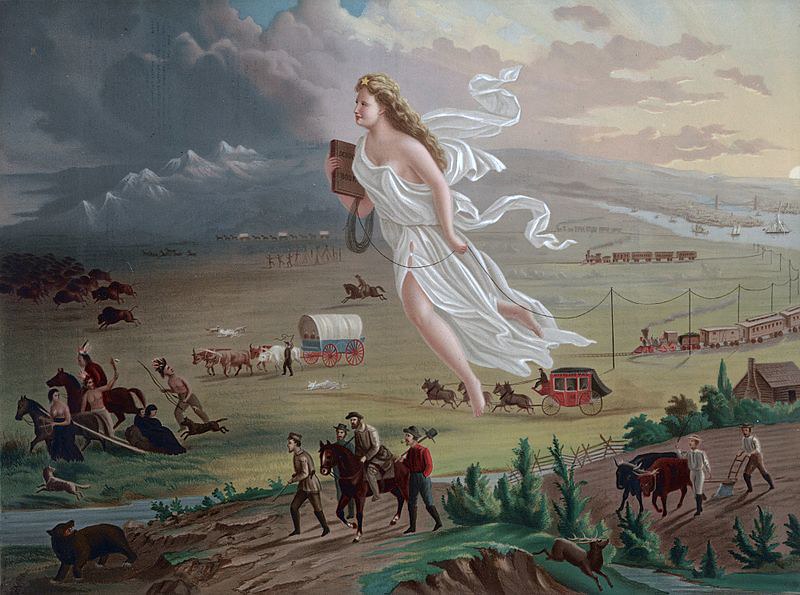
Manifest Destiny was never merely about territorial expansion; it was an assertion of America’s role as a civilizational force, exemplified by the construction of transcontinental railroads, the spread of industrial innovation, and the global influence of American democratic ideals. It was the belief that the republic had a unique destiny to spread its values, industry, and ingenuity across untamed frontiers. The railroad, the telegraph, and the industrial boom of the late 19th century were all manifestations of this ethos. The same impulse that pushed settlers westward now demands a new outlet. Mars, with its vast, barren expanse, is the 21st-century frontier, the logical extension of the American project. The technological renaissance required to settle another planet would inevitably fuel new economic and military advantages, reinforcing the United States’ status as a dominant global power. Just as the Monroe Doctrine ensured that European imperialism would not dictate the Western Hemisphere’s future, a renewed Manifest Destiny in space ensures that authoritarian regimes will not define the next great human endeavor.
However, the emergence of SpaceX, led by Elon Musk, a visionary and a leading figure within the Trump administration, signals a potential revival of this expansionist vision. With the necessary technical expertise and a leadership cadre willing to challenge conventional constraints, there exists a genuine opportunity to extend Manifest Destiny beyond Earth, with Mars as the next frontier.
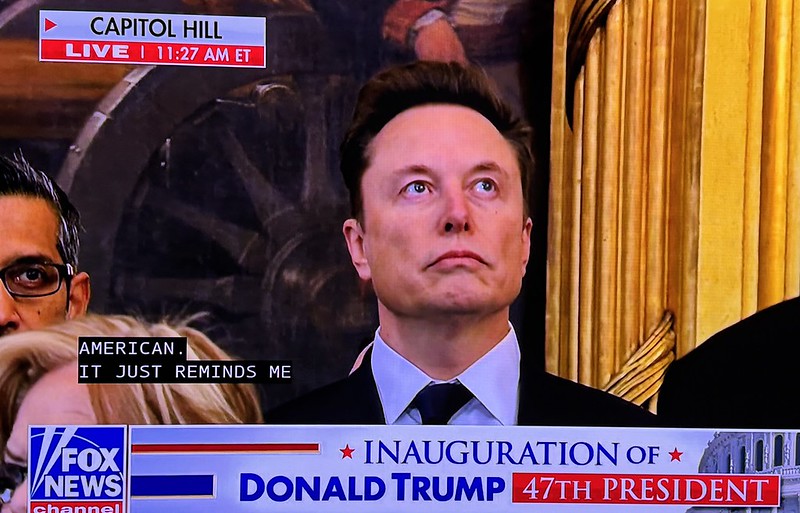
Whether through enforcing an updated Monroe Doctrine or rekindling expansion into space under the banner of a renewed Manifest Destiny, these ideas remain fundamentally aligned with the core interests of humanity. America’s expansion across the seas and into space is not an act of aggression but a historic imperative—an opportunity for the Free World to reclaim its trajectory in the face of revisionist empires such as China, Russia, and Iran. After decades of self-loathing, cultural self-flagellation, and ideological nihilism, this is the long-overdue paradigm shift that can unify patriotic citizens and industrial-technological elites alike. Above all, this shift signifies the return of history—this time, with a renewed sense of purpose and optimism. Whether through territorial security or interplanetary ambition, America faces a choice: embrace its pioneering spirit or risk ceding its leadership in the next great frontier.
Ziya Hasanli is a Contributor for Liberty Affair. He lives in Warsaw, Poland. Follow him on X: @hsnlizi