What Happened to Barnard? How My Alma Mater Became a Hotbed of Anti-Israel Groupthink
As a higher education reporter of nearly a decade, I have witnessed the far left’s progressive orthodoxy worm its way deeper and deeper into academia. Despite President Trump’s missives on DEI and antisemitism in education, the rot has never seemed worse.
In this environment, it’s almost impossible to find anyone — students or professors — who will admit they hold conservative or unorthodox views on any topic.
To be public about those views can amount to social or career suicide, especially when the overwhelming majority of students lean liberal and support the pro-Hamas protests against Israel.
Nearly every college boasts about diversity. Yet diversity statistics deftly conceal that there is one type of diversity they not only lack but actively shirk: political diversity.
At colleges across the nation, progressive ideology reigns supreme. If progressivism is queen, then academia is her throne. And in this regime, where progressive ideologues are vaunted — particularly fringe liberal ideas — the monarchy cannot tolerate dissenters. Heretic! Apartheid supporter! Zionist! Cis-heterosexist, racist homophobe! the students snarl.
In a 2025 study at Duke University, 62% of professors said they were “very liberal” or “somewhat liberal.” Meanwhile, only 13% identified as conservative. The rest claimed to be moderate, but it’s likely many liberals concealed their true alignment.
Over at Yale University, the Buckley Institute discovered that 77% of professors were registered Democrats, with Democrats outnumbering Republicans by a ratio of 28:1. The study found just four Republican professors — yes, fewer than a handful.
Even in math departments, Democrats outnumber Republicans by a ratio of 4:1, according to a 2025 study published by The College Fix.
Which I find strange. Isn’t one of the hallmarks of the college experience learning and debating with people you don’t agree with? The debate of ideas? Learning to agree to disagree?
Academia can’t tolerate Republicans to the point where they’re less likely to be hired. With job applications often including a section for “showing commitment to diversity” — and plenty of rumors about HR offices checking voter registration before hiring — this is a recipe for disaster.
This ideological homogenization of academe is detrimental to a well-rounded education. And giving students a well-rounded understanding of global politics, such as the war on Israel? Forget about it. This must end.
According to Nicholas Kristof, writing in The New York Times, studies have pegged the proportion of Republican professors in the humanities at roughly 6% to 11%. In some cases, he notes, it’s easier to find a Marxist than a Republican in academia. In my experience, that’s true.
And I find this tragic. But why? I was raised with socially and economically leftist views; I’ve worked with nonprofits for causes including welfare, food stamps, LGBTQ rights, racial minorities, and the environment. I should have been glad to be taught by professors who support the same causes, right? Wrong.
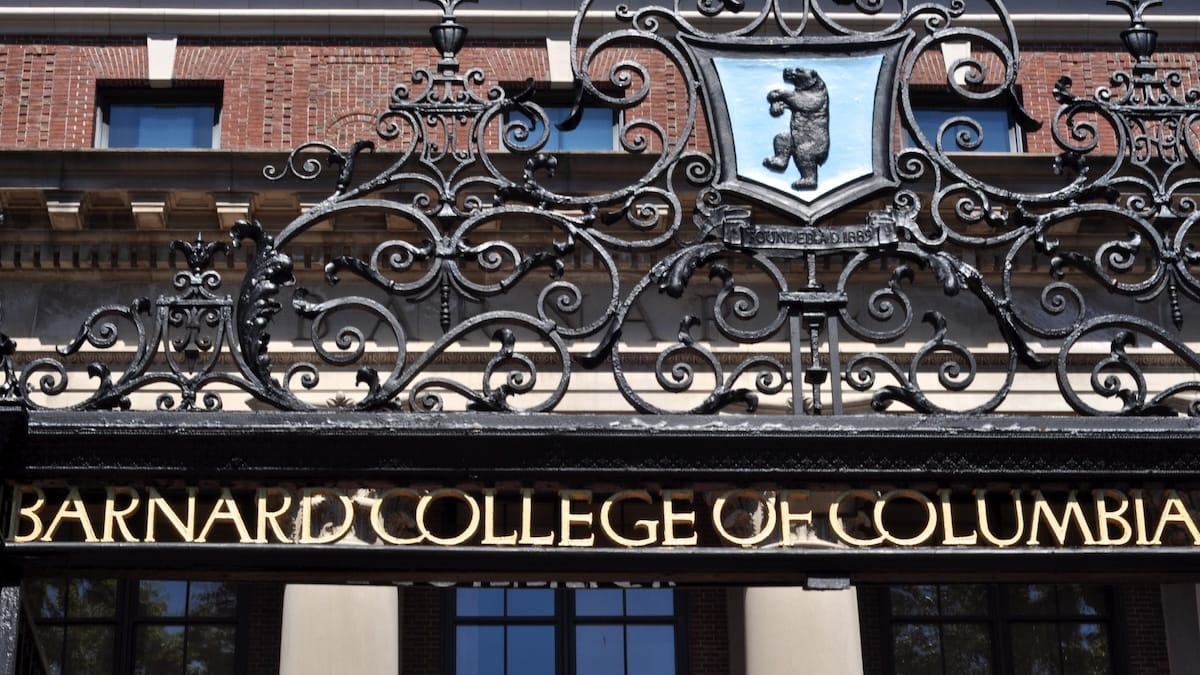
I graduated from Barnard College. I also took classes at Columbia University and the Columbia School of International and Public Affairs, one of their graduate schools. I’ve also been reporting on politics in academia for years, and Republican and Libertarian professors are quickly attacked and ousted.
I saw this ideological orthodoxy firsthand at Columbia, where I was attacked and harassed for my perceived right-wing views because I supported Israel. Getting stalked, receiving thinly veiled death threats, and being forced to switch dorms mid-semester were all things I endured for standing with Israel.
The fact that most students have never been taught by an openly right-wing professor means they’ve never had a professor they disagreed with. When I’ve asked my right-leaning friends and colleagues, none of them could recall a time when they seriously disagreed with a professor, either.
Thus, students are in a state of intellectual poverty — stuck in dystopian campus enclaves, never exposed to alternative ways of thinking. Last year, at my alma mater, 90.99% of students voted against Israel. Intellectual diversity, much?
The first problem is that this subordinates students’ political consciousness to homogenized groupthink. Professors are powerful; students look up to them. The opinions a professor holds will inevitably shape their students.
Although professors are expected to be politically neutral in the classroom, in reality, few are. Most seem to be moderate or progressive — which is fine. I’ve even enjoyed when professors bring their values and anecdotes to class; it’s easier to learn from a person when I know something about them. Otherwise, professors can seem cold and robotic, like tape recorders.
I’m not advocating for an ideology-free curriculum, but rather a professoriate with a multiplicity of views — so students aren’t pushed too far into the maw of one ideology. As the Foundation for Individual Rights and Expression found, only 1 in 10 students surveyed opposed the anti-Israel, pro-Hamas protests and encampments we saw last year.
The failure of universities to employ openly conservative professors means many students will rarely encounter, let alone debate, opposing views. But how does one skillfully defend their beliefs if they don’t know what the opposition believes?
Another issue is the way people caricature the political right because of such limited exposure. If you’ve never met a conservative, it’s easy to reduce them to stereotypes: “Trumpers,” “anti-American,” “Zionists,” you’ve heard it all.
I should know. It wasn’t until after college that I realized — despite what I was taught growing up — conservatives don’t hate women, gays, racial minorities, or poor people. They simply use a different logic and draw on a different value system.
For most college students, this lack of exposure also deprives them of learning about the principles of conservative and libertarian thought — rendering them unable to engage respectfully with people they perceive as enemies based solely on Facebook posts or memes.
Take, for example, the common progressive trope: a conservative man who is against abortion must hate women and want to control their bodies. When in reality, that man may believe an unborn baby is an innocent life. He may follow a religion that teaches the sacredness of life from conception. Or he may simply believe fathers should have rights, too. Who’s to say?
More recently, it’s become commonplace for students to demonize Jews. Since the majority of Jews support Israel’s existence (which is different from supporting the government or the IDF’s actions), the idea is that all Jews are — as often taught in sociology classes — “neo-colonialists” or “Zionists.”
But can you really fight an ideology you don’t understand? If colleges are training grounds for democratic citizenship, how can they justify graduating students fluent in only one anti-Israel, anti-male, anti-free speech ideology?
When students are indoctrinated into a leftist orthodoxy that neglects to teach the beliefs of the opposition, they aren’t just unequipped to fight it — they’re unequipped to recognize when the opposition might actually be worth listening to.
This essay was adapted from Toni Airaksinen’s prior writings. Her work has appeared in the Times of Israel, USA TODAY, Quillette, and dozens of other publications. Follow her on X @Toni_Airaksinen and on Instagram.