Will Netanyahu Choose to Be Washington or Roosevelt?
This essay was written by Z.E. Silver, a modern historian who created Gam v'Gam Media.
Shalom friends,
On the heel of Netanyahu's visit to the White House today, Prime Minister Benjamin Netanyahu has been in the Israeli political sphere for over thirty years. Despite the ebbs and flows of his career, his biggest detractors and harshest critics would have you believe that he’s been the King of Israel since its inception. Certainly since his reintroduction in the latter part of the 21st Century’s first decade, Netanyahu has been as such for all intents and purposes. Unlike the authoritarians and fascists his detractors and critics accuse him of being, he is ultimately a byproduct of the Israeli electoral system. Israel does not have a constitution and they have no limits on how long one can serve as Prime Minister. Netanyahu is no more of a dictator than was George Washington or any other American president prior to Franklin D. Roosevelt who voluntarily chose to serve only two terms.
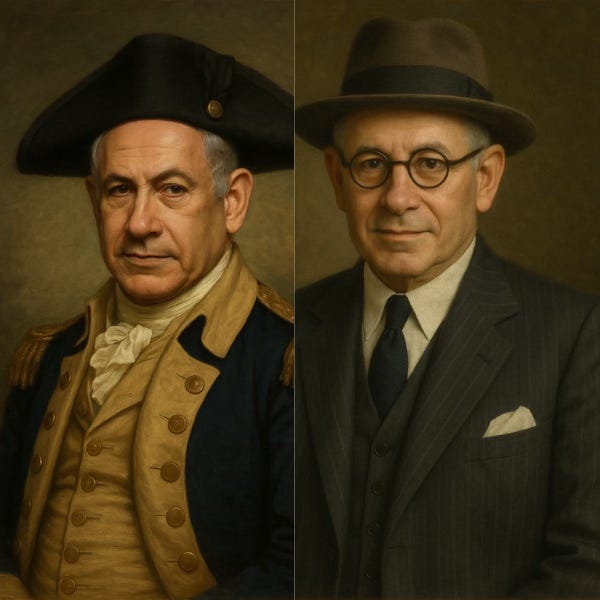
I use those examples as the bookends because Netanyahu has a choice between being the George Washington of Israel or the FDR. At first, this comparison might seem odd given that Netanyahu is neither Israel’s first leader nor is he bastion of liberalism. However, when it comes to one specific act of leadership and devotion to the greater good, these two presidents provide the perfect juxtaposition.
Prior to the adoption of the 22nd Amendment, American presidents chose to limit themselves to only two terms as president. We don’t discuss the idea of “political norms” in today’s discourse because most people aren’t sophisticated enough to understand it. In essence, it is a precedent mutually respected by those who consider each other their political opponents. No law forbids the act of violating it, but the taboo of doing so is considered so heinous, it might as well be. American presidents serving only two terms was a political norm, set down by George Washington.
“…in withdrawing the tender of service, which silence in my situation might imply, I am influenced by no diminution of zeal for your future interest, no deficiency of grateful respect for your past kindness, but am supported by a full conviction that the step is compatible with both.” - Farewell Address, 1796
Washington had just fought off authoritarian rule, and understood that, despite no law forbidding him from seeking a third term, doing so would encourage others. John Adams would have pointed to Washington to justify running beyond two terms, Jefferson would have done the same, and each subsequent president for all time. To avoid even the possibility of a president seeking authoritarianism through democratic majority, Washington made the decision to give up power and set America on the complete opposite path. From the first president to the 31st president, not a single one (other than Grant who lost the nomination) sought a third term. Franklin Delano Roosevelt, the Democratic Party’s idol, was the first to violate this norm. Given that his third term was at the beginning of World War II, it’s understandable why he believed he was justified in breaking this tradition—then again, that’s what all despots say.
“However, when it comes to one specific act of leadership and devotion to the greater good, these two presidents provide the perfect juxtaposition.”
Each president could have made the same argument from Washington through Hoover. Any of the first several presidents could have justified remaining in office due to the youth of the country. Those elected in the heart of the 19th Century could have used the ongoing battle against the imperial powers that remained on the continent, the war against the Native Americans, or even the prevention of slave states as reasons for remaining in power. Yet none of them did because to violate that political norm would have led our country down a path to someone like Roosevelt. Thankfully, because of our Constitution, and because this political norm was so sacred, the 22nd Amendment was passed. Had Roosevelt decided to end his presidency after defeating both Nazi Germany and Imperial Japan, I wonder if it would have had as much support. Either way, unlike Washington who believed in putting his country above his own ego, Roosevelt chose the opposite. Overall, the 22nd Amendment is a good thing. While many who wish Obama would’ve been able to run for a third, fourth, or fifth term, those same people are certainly thankful that Trump can only run for two (despite their belief he will find a way around it).

Netanyahu is now faced with the same choice. He is not Israel’s first Prime Minister, but in this brave new post October 7th world, it does seem like he is the first in Israel’s next phase. It’s not a secret that Netanyahu believes the reason he was put on this earth was to ensure the Islamic Republic of Iran never builds a bomb. In the aftermath of Operation Rising Lion, it seems he has accomplished his life’s goal. While I’m no fan of his, I also don’t believe he’s evil or maniacal. I believe he loves his country and the Jewish people. More importantly, he believes what he has achieved will place him in the pantheon of not only Israeli leaders, but Jewish ones.
As I’ve mentioned previously, Netanyahu simultaneously is the reason Israel is in this mess and he was the only man who could’ve maneuvered Israel out of it as well. While Israel might have lost many allies in the West, it has gained the respect of its neighbors and those in the East. Israel might not be the darling of the world, but it has never been in a better position to solidify its place in the global community. Hezbollah’s grip over Lebanon is severely weakened; Hamas is going to be rooted out of Gaza; the Palestinian Authority’s credibility is in the sewer; Syria doesn’t want any smoke; the Islamic Republic has been exposed as a paper tiger; the Houthis are headless; and the UAE and Saudi Arabia are just waiting to sign the dotted line on the Abraham Accords.
None of this is possible without Netanyahu, and his complex legacy will reflect that in the years to come. However, if he wants to solidify his legacy as a great leader who was complicated instead of a would-be authoritarian who was stopped, he should volunteer not to run in the next election.
Netanyahu should recognize that he ultimately achieved his life’s work. Even if the Islamic Republic’s nuclear program isn’t entirely dismantled, the regime itself is closer to collapse than to recovery. He might have been the reason Israel was in a seven-front war, but he also led Israel to victory on all seven fronts. That doesn’t mean he has to leave politics.
He could easily take the mantle of President in order to continue steering Israel’s position into the Abraham Accords. Prime Minister Netanyahu has a chance to be the man who will be known as the heroic leader who led Israel through the fire and came out as a shining phoenix ready to light up the sky. Or he could be known as the man who simply wanted to hold onto power and die in office.
Legacies are complicated for every political leader. We usually judge them based on what they did as their time in power concluded. We remember Nixon for Watergate and Lincoln for uniting the country after the bloody civil war.
We remember Washington for being the man who put his country above himself. We remember FDR for defeating the Nazis, but also as the man who lied to the public and died from his lie. Netanyahu can be remembered as the man who led Israel into its future or he can be remembered for sacrificing it to remain in power. I hope he makes the right choice.
This essay was written by Z.E. Silver, who publishes the newsletter, “Gam V’gam.” He is a political and cultural commentator focused on politics both in the U.S. and abroad, with an emphasis on Jewish peoplehood, antisemitism, and Israel. Find him on X @z_e_silver. Follow his Substack.